
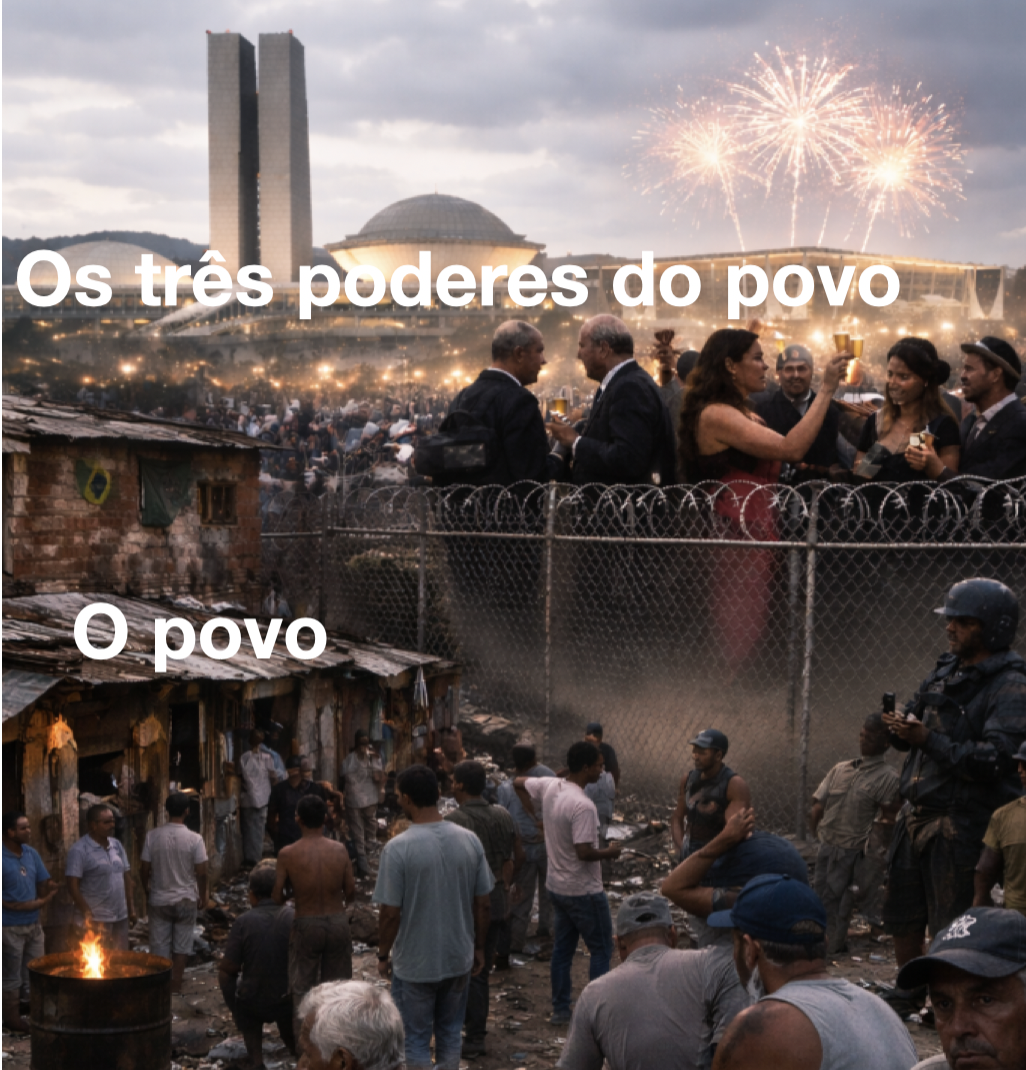
Tolerance of the Wrong – When Stillness Becomes Dance
“I said to my soul, be still and wait without hope, for hope would be hope for the wrong thing; wait without love, for love would be love of the wrong thing; there is yet faith, but the faith and the love are all in the waiting. Wait without thought, for you are not ready for thought: So the darkness shall be the light, and the stillness the dancing.” T. S. Eliot
In Brazil, injustice is not sustained by force alone. It is sustained by waiting.
The calm demanded of the soul, the discipline of endurance, the suspension of reaction – these are no longer spiritual exercises but social conditions. The population has learned, generation after generation, to wait without rupture, to persist without transformation, to believe that what is intolerable must be endured until it somehow becomes meaningful. Waiting ceases to be a path; it becomes a structure. From this perspective, the system has remained essentially unchanged since the false promise of “Order and Progress” declared in 1889.
Hope is postponed. Love is redirected. Thought is deferred.
And in this deferral, the system breathes.
Between structural violence, persistent inequality, and the detachment of the three branches of power from the lived reality of the majority, a culture has emerged in which injustice no longer needs justification – it only needs continuity, generation after generation. The citizen waits for justice that never arrives, for institutions that fail to respond, for reforms that are endlessly announced yet never realized. The language of improvement replaces improvement itself.
Darkness does not become light. It becomes managed.
Stillness does not remain silence. It becomes movement – habitual, repetitive, socially accepted. A choreography of adaptation takes shape: living with the absurd, adjusting to corruption, normalizing humiliation, internalizing limits. Life continues, but within the boundaries of what should not be acceptable.
The movement is real. The transformation is not.
This is how error stabilizes itself. A society that learns to endure what undermines it also learns to sustain it. Tolerance toward wrongdoing ceases to be an exception and becomes a function. The system does not require legitimacy; it requires continuity. It survives not because it is just, but because it is endured.
The three branches of power, entrusted with correction and protection, operate instead as mechanisms of distance. Not through constant crisis, but through constant persistence. What is reproduced is not only inequality, but the conditions that make inequality livable. The burden remains with the majority; the benefits concentrate elsewhere. The structure holds.
And the soul remains calm.
Not because there is peace, but because exhaustion has learned to resemble discipline. Not because there is resolution, but because waiting has replaced refusal.
In the end, the tragedy is not only that injustice exists, but that it can be lived with – continuously, collectively, without collapse. When stillness becomes dance, the system no longer needs to hide. It can coexist with normality, with civility, with routine, even with the language of democracy.
And precisely for that reason, it endures.
The image shows: On one side, the three branches of power celebrate their authority and financial strength; below, the people are left dependent on — and subjected to — a system of power and injustice.