
Foreign Economic Policy Instead of Morality
The present text examines a state-supported instrument designed to create favorable conditions for national companies abroad and situates it within the tension between two opposing concepts: foreign economic policy and morality.
In the course of revisiting the history of economic relations between Brazil and Germany, I came across older materials on Germany’s former approach to foreign bribery and once again took the time to research whether there are newer publications and more recent interpretations on the subject.
Historically, foreign bribery in Germany was for a long time not prosecuted under criminal law in the same way as it is today; for German companies, it was in fact doubly privileged: for many years it was not effectively punishable, and such payments could even be deducted for tax purposes in Germany until the end of 1998. Only from 1999 onward were foreign bribery and its tax advantages effectively brought to an end – also under international pressure.
This history is by no means hidden; it can easily be researched on the internet. As early as the beginning of the new millennium, I had collected a great deal of material on the subject, though later I only engaged with it occasionally. It was only a renewed examination of the issue – prompted by a corruption case in Brazil and a related query to ChatGPT – that brought the underlying logic back before my eyes with full clarity: foreign economic policy instead of morality.
The historical interpretation of this finding points to a fundamental tension between foreign economic policy and morality. History makes it abundantly clear that German interests – including the interests of German companies – were not to be placed at a disadvantage in international competition from the German point of view. Against this background, corruption abroad in a country as heavily dependent on foreign trade as Germany was often understood not primarily as a moral or political problem, but rather as a practical risk of cross-border business activity. Accordingly, the objective was to deal with this problem as discreetly, efficiently, and quietly as possible. In this, the German system proved remarkably effective for a long time.
This perspective is analytically revealing. It shows that foreign economic policy must not be understood exclusively as a neutral field of economic exchange. Rather, it is always also a powerful component of state interest politics. Terms such as competitiveness, market expansion, or the safeguarding of business locations often appear as technical and objective categories, yet they also carry significant implications of power politics.
It is particularly revealing to examine how Germany, across its different political systems, conducted foreign economic policy, which actors were involved, and by what means it succeeded in securing favorable conditions, for example in Brazil. Brazil has never learned to do this in a comparable way. I would argue that Brazil’s positive image in its partner countries is largely derived from its geography, the vitality of its people, its culture, and the characteristic openness and friendliness of Brazilians in their interactions. By contrast, little admiration arises from the way in which the three branches of government govern the Brazilian state.
The German state and its three branches of power, on the other hand, have repeatedly acted with considerable effectiveness in the interest of their country and its citizens. Even after wars, Germany recovered relatively quickly and was able to improve the quality of life of its population at a remarkable pace. The comparison with Brazil is therefore sobering: it is striking how little the three branches of power in Brazil have delivered for large parts of the population since 1889.
The formula “foreign economic policy instead of morality” thus condenses the insight that, in certain historical contexts, economic rationality took precedence over normative standards. For this very reason, it is worth critically examining the language used to justify foreign economic policy. Wherever political and economic interests appear merely as technical necessities, their normative foundations easily fade from view.
From this perspective, foreign economic policy cannot be understood historically only as a practice of trade, but also as an instrument of state influence. In a pointed, metaphorical sense, one might say that for the German economy, foreign economic policy today fulfills a function similar to that performed by other instruments of power in earlier epochs: opening access to foreign spaces and securing favorable conditions for its own interests. Such an analogy is not literal, but it is analytically revealing.
In every form of state, the state acts through its organs of power, while the population must live with the consequences.
If one dares to draw a historical analogy, a recurring pattern becomes visible: Germany has, across very different periods, demonstrated an ability to develop instruments to expand its scope of action and secure advantages for its own interests. The Teutonic Order did so with the means of its time; modern foreign economic policy does so with the means of the present. The beneficiaries of this action were not only German companies and ruling elites, but also, in many cases, citizens of German origin – both in the home country and in the regions where German interests were asserted. In Brazil, by contrast, the gains were concentrated among a small minority, while the broader population bore the social, political, and economic costs.
States such as Brazil, which over long periods of their history did not focus consistently on their own development, provided favorable conditions for states like Germany. Whoever deals with a politically, economically, and institutionally highly organized actor is not facing a neutral partner, but a state that knows how to pursue its interests intelligently, persistently, and effectively – even, if necessary, at the expense of the population of the countries in which those interests are asserted.
At the same time, the following also applies: those who do not truly respect their own population internally, who tolerate social inequalities and repeatedly subordinate moral standards to economic or power-political interests, cannot be expected to act differently externally. This applies not only to states, but also to institutions that proclaim far more moral values than they have ever historically fulfilled. Not even the Church, which preaches a fundamentally different ethic, has been an exception.
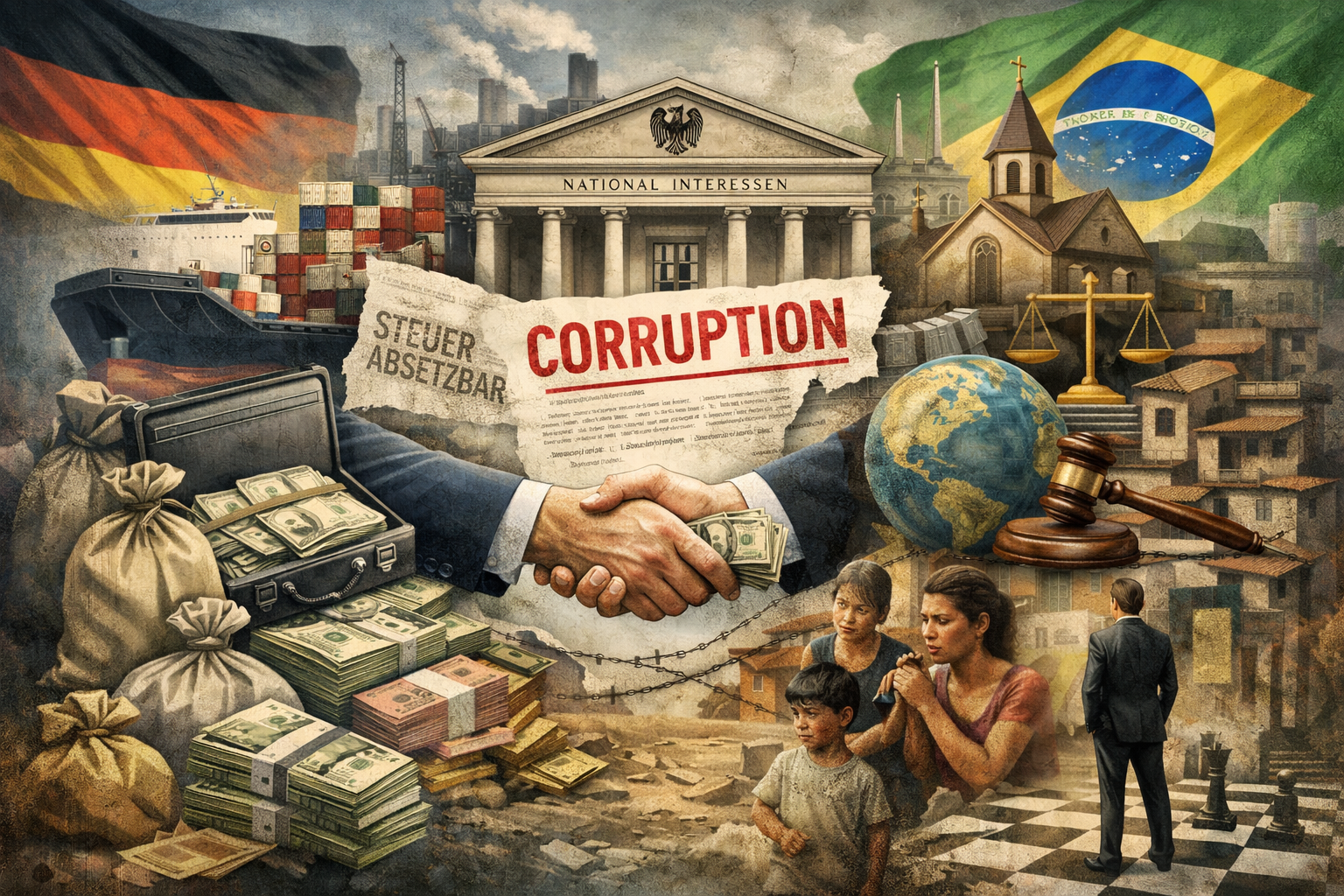
The article’s image depicts a fictional scene set in the historical context of Germany’s former handling of foreign bribery in the 1980s and 1990s.