China and Brazil: Religion, State Power, and Diverging Paths of Development
14.03.2026
The comparison between China and Brazil is not only economic or political. It is also civilizational.
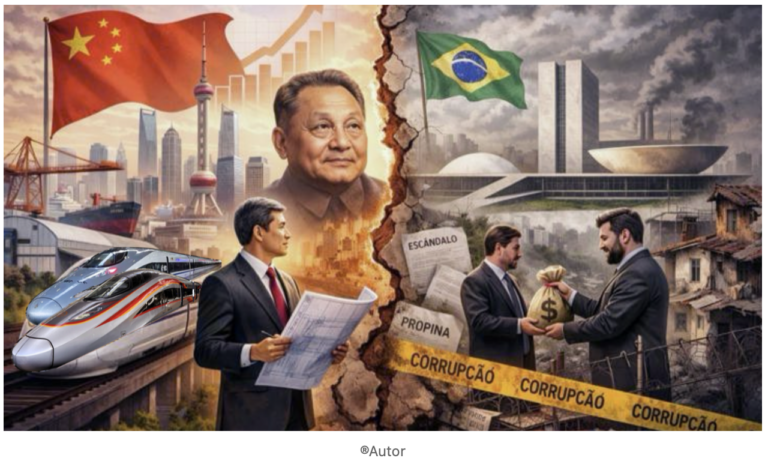
China and Brazil are both continental-scale countries. Each possesses vast natural resources, large populations, and significant geopolitical potential. Yet over the last half century their development trajectories have diverged dramatically.
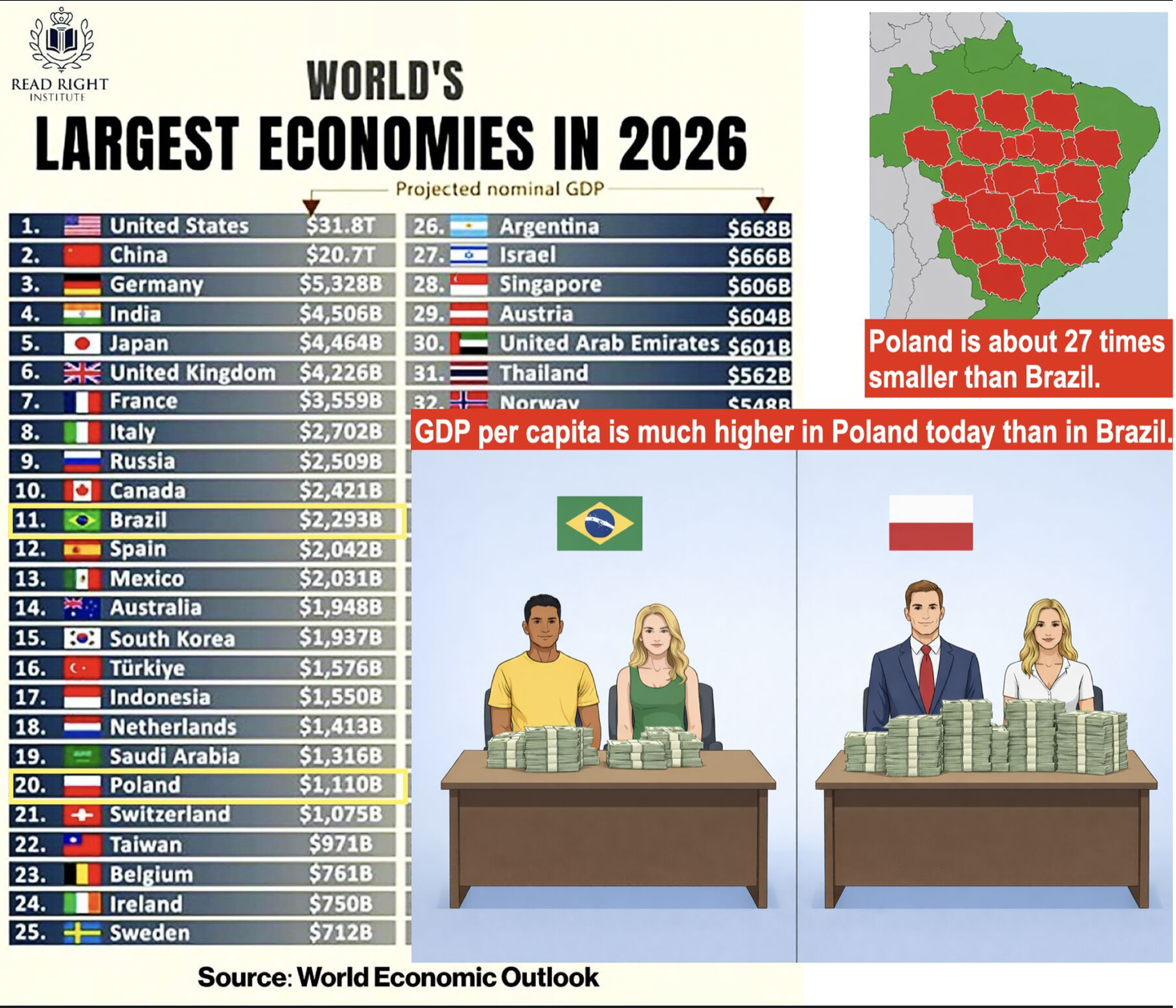
China has emerged as one of the most powerful economic actors in the world, transforming itself from a largely agrarian society into a technological and industrial powerhouse. Brazil, despite its enormous agricultural wealth, mineral resources, and demographic scale, has struggled to achieve comparable levels of industrialization, technological capacity, and long-term strategic development.
The contrast between the two countries cannot be explained simply by economics. It reflects deeper differences in state capacity, political culture, institutional discipline, and strategic planning.
China: A State Organized for Long-Term Power
Chinese governance has long prioritized centralized authority, administrative competence, and long-term strategic planning. Unlike many civilizations, political authority was not shaped by organized religion but by state institutions and philosophical traditions.
For more than two millennia, Chinese political culture was shaped by Confucian administrative philosophy. Confucianism emphasized meritocratic leadership, disciplined governance, and the moral responsibility of rulers to preserve order and prosperity. Officials were traditionally selected through rigorous examinations that rewarded education and administrative competence.
Although modern China operates under the rule of the Chinese Communist Party, echoes of this historical tradition remain visible in the emphasis on technocratic expertise, elite training, and long-term state planning.
Strategic thinking also occupies a central place in Chinese political culture. Ideas associated with Sun Tzu stress patience, indirect influence, and long-term positioning rather than short-term tactical victories. Modern initiatives such as major infrastructure expansion, technological industrial policy, and global economic networks reflect this strategic orientation.
Another distinctive feature of Chinese civilization is the limited political role of religion. While China contains diverse religious traditions – including Buddhism, Daoism, Islam, Christianity, and folk practices – religion rarely developed into an autonomous political authority capable of competing with the state. Governance historically rested on philosophy, bureaucratic administration, and political order rather than religious institutions.
Today, China remains a largely non-religious society in which religion plays a cultural or private role while national strategy and economic planning are driven primarily by the state.
Mao’s Rupture and the Return of Pragmatism
China’s modern history was not without major disruptions. Mao Zedong’s rule represented a dramatic break with earlier traditions of pragmatic governance.
Campaigns such as the Great Leap Forward and the Cultural Revolution attempted to reshape society through revolutionary ideology and mass mobilization. These policies produced severe economic dislocation, institutional destruction, and widespread human suffering.
After Mao’s death in 1976, Chinese leadership began to restore a more pragmatic model of governance. Deng Xiaoping’s reforms in the late 1970s introduced market mechanisms, reopened the country to global trade, and reemphasized education, expertise, and economic modernization.
The resulting model – often described as “socialism with Chinese characteristics” – combined centralized political authority with long-term economic planning and gradual reform. Over the following decades this system enabled China to sustain one of the fastest economic transformations in modern history.
Brazil: Wealth Without Strategic Development
Brazil’s historical trajectory presents a stark contrast.
Few countries possess a natural resource base comparable to Brazil’s. The country is rich in agricultural land, water resources, energy potential, and mineral deposits. Its territory is vast, its population large, and its geopolitical position significant.
Yet despite these advantages, Brazil has struggled to transform its resources into sustained industrial power and technological leadership.
Several structural factors help explain this paradox.
First, Brazilian politics operates within short electoral cycles that often disrupt long-term policy continuity. Governments frequently change direction, making it difficult to maintain coherent national strategies across decades.
Second, institutional fragmentation complicates coordinated decision-making. Multiple political actors, regional interests, and party coalitions compete for influence, often producing policy instability.
Third, Brazil has repeatedly faced large corruption scandals involving political leaders, state-owned companies, and private contractors. Investigations such as Operation Car Wash revealed complex networks of illicit financing and political patronage embedded in parts of the political and economic system.
These patterns have contributed to the perception that segments of the political and economic elite have been able to accumulate significant wealth through privileged access to public contracts, financial networks, and political influence. When corruption becomes systemic, it can weaken public trust, distort resource allocation, and hinder long-term modernization.
In such an environment, reforms often become politically contested battles among institutions rather than coordinated national projects.
Elite Capture and the Limits of Reform
Another challenge facing Brazil is the persistence of powerful political and economic elites that have historically exercised strong influence over state institutions.
In democratic systems, elite influence is not unusual. However, when elite networks intersect with patronage systems, party financing structures, and weak accountability mechanisms, they can create conditions that make structural reform extremely difficult.
Brazil’s development model has produced a persistent paradox: a country endowed with vast natural resources yet unable to translate that wealth into sustained modernization. Instead of functioning as instruments of national strategy, public institutions are often absorbed by constant political competition, regional rivalries, corruption scandals, and short-term electoral calculations.
The result is chronic political paralysis precisely at the moments when decisive structural reforms are most necessary. Infrastructure modernization, deep educational reform, and coherent industrial policy repeatedly stall in a system dominated by fragmented interests and entrenched elites. While other nations convert resources into long-term national power, Brazil too often dissipates its potential through institutional inertia and political capture.
State Capacity, Human Capital, and Social Order
Differences in state capacity between China and Brazil become particularly visible in education, workforce development, and public security.
China has systematically invested in human capital, especially in engineering, science, and technological fields. Universities, technical institutes, and state-supported research programs have produced a large domestic pool of highly trained professionals capable of supporting national industrialization. This strategy has allowed China to build globally competitive manufacturing sectors and technological industries largely driven by its own engineers, scientists, and managers.
Brazil, by contrast, has historically struggled to place comparable emphasis on the large-scale development of technical and scientific expertise within its own population. While access to education has expanded over recent decades, persistent inequalities in quality, training, and institutional capacity continue to limit the formation of a highly specialized domestic workforce.
As a result, important segments of Brazil’s industrial development have often relied heavily on foreign technical expertise, imported managerial know-how, and external engineering capabilities. In many cases, industrialization occurred through technology transfer rather than through the systematic cultivation of national technical leadership.
The aerospace company Embraer illustrates both the possibilities and the structural challenges of Brazil’s development model. Founded with significant state support, the company eventually became one of the world’s leading regional aircraft manufacturers. Yet its early technological development depended heavily on international cooperation, foreign-trained specialists, and partnerships with global aerospace firms. The case demonstrates that Brazil can build world-class companies, but it also highlights how industrial progress has frequently relied on external expertise rather than the large-scale development of domestic engineering and managerial capacity.
These structural weaknesses in human capital development are compounded by broader governance challenges. Brazil faces persistent problems related to urban crime and organized criminal networks, particularly in major metropolitan regions. High levels of violence and insecurity impose substantial economic costs by discouraging investment, straining public institutions, and undermining social stability.
China presents a stark contrast. Strong centralized law enforcement and extensive state authority over public security have kept crime rates relatively low compared with many large developing economies. Combined with sustained investment in education and technological training, this has allowed the Chinese state to align social stability with long-term economic development.
In the long run, the ability of a nation to modernize depends not only on natural resources or capital investment but on the systematic development of its own human talent. China has pursued this objective as a national strategy. Brazil, despite its vast potential, has too often postponed it.
Two Models of National Organization
Ultimately, the divergence between China and Brazil reflects two very different models of national organization.
China’s system is characterized by:
- strong centralized state authority
- long-term economic planning
- disciplined bureaucratic administration
- relatively limited political influence of religion or independent social institutions
Brazil’s system reflects:
- democratic competition and electoral turnover
- strong social influence of religion and civil society
- fragmented political authority
- persistent challenges related to corruption, inequality, and institutional coordination
These differences shape how each country mobilizes resources, formulates policy, and pursues long-term development strategies.
The Geopolitical Consequences
The geopolitical implications of this divergence are significant.
China’s rapid industrialization has allowed it to become a central actor in global manufacturing, technology, infrastructure investment, and international trade networks. Its ability to sustain long-term national strategies has strengthened its position in global power competition.
Brazil, despite its enormous natural advantages, has struggled to convert its potential into comparable geopolitical influence. Without sustained institutional reforms, the country risks remaining primarily a supplier of agricultural and raw material exports rather than emerging as a fully diversified industrial and technological power. This trajectory represents a serious strategic danger for Brazil’s near future. If entrenched elites continue to prioritize the preservation of their own advantages over genuine national development, they reinforce a political and social culture in which personal enrichment appears more rewarding than productive effort, long-term national investment, and the development of the advanced skills that Brazil urgently needs among its own citizens. Such dynamics risk leaving Brazil structurally unprepared for an increasingly competitive and technological global order, gradually weakening its geopolitical position and reducing its capacity to act as a major power on the international stage.
the country risks remaining primarily a supplier of agricultural and raw material exports rather than emerging as a fully diversified industrial and technological power.
The comparison between China and Brazil exposes a stark truth about development: nations rise or stagnate according to how their political systems organize power, discipline elites, and invest in the capabilities of their people.
China’s modern transformation was not accidental. It emerged from a state that, despite ideological upheavals, ultimately reorganized itself around strategic planning, institutional discipline, and the systematic cultivation of human capital. Over the past four decades, China turned poverty into industrial capacity, invested relentlessly in science and engineering, and built the infrastructure and institutions required for long-term national power.
Brazil followed a very different path
The country possesses extraordinary natural advantages: vast agricultural land, immense mineral reserves, abundant water resources, and a large population capable of sustaining a powerful internal market. Yet these advantages have repeatedly failed to translate into sustained modernization.
The reasons lie deep in Brazil’s historical structure of power
From the imperial period onward, political authority was concentrated in a narrow elite that looked to Europe for cultural legitimacy while maintaining rigid social hierarchies at home. The monarchy did not build a modern national project centered on the development of its people. Instead, it preserved a social order designed to protect privilege, maintain land concentration, and reproduce elite dominance.
When the monarchy ended, many of these structures remained intact. The republic changed political forms, but the underlying logic of elite continuity persisted.
For generations, Brazil’s ruling classes invested more energy in preserving their position than in transforming the country. Rather than constructing a unified national development strategy, political power remained tied to patronage networks, regional oligarchies, and systems of privilege that resisted deep structural reform.
The consequences were profound
Development in Brazil became geographically selective. Political attention, investment, and industrialization concentrated heavily in the more Europeanized regions of the South and Southeast, while vast parts of the country were systematically neglected. Regions considered “too Brazilian” – with strong indigenous, African, and mixed cultural identities, particularly the Northeast – were often treated as peripheral to the national project rather than integrated into it. Instead of becoming engines of national modernization, these regions were historically marginalized, reinforcing deep structural inequalities and fragmenting Brazil’s development as a unified nation.
This imbalance prevented Brazil from modernizing as a cohesive nation. Infrastructure, education, industrial capacity, and institutional development advanced unevenly, reinforcing the fragmentation of the country rather than overcoming it.
At the same time, corruption scandals repeatedly exposed how political and economic elites could accumulate wealth through privileged access to the state. These networks of influence did not merely distort public policy – they entrenched a system in which reform itself became dangerous to those who benefited from the status quo.
The result is a persistent national paradox: a country of immense wealth that repeatedly fails to mobilize its resources for long-term modernization.
While China built a development model based on disciplined state planning, technological investment, and the systematic training of engineers, scientists, and industrial managers, Brazil often relied on imported expertise while neglecting the large-scale development of its own human capital. The country produced islands of excellence, but never constructed a coherent national strategy capable of transforming potential into power.
This is the painful reality Brazil rarely confronts.
The country’s greatest obstacle is not a lack of resources, nor a lack of talent among its people. It is the durability of a political and social structure that has historically prioritized the preservation of elites over the modernization of the nation.
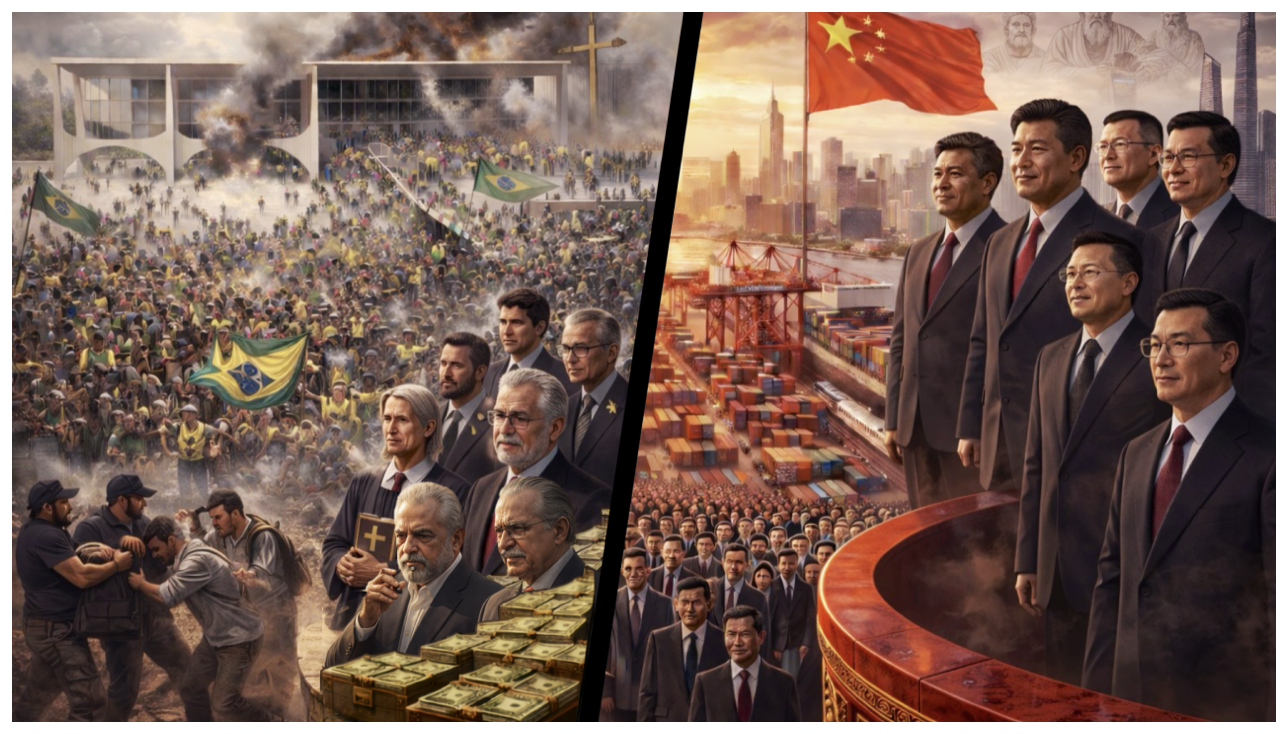
China demonstrates what happens when a state mobilizes its society toward long-term national objectives. Brazil illustrates what happens when historical privilege, regional imbalance, and institutional fragmentation repeatedly derail such a project.
Until Brazil confronts the structural legacy of its past – elite continuity, unequal regional development, and the absence of a disciplined national strategy – it will remain trapped in a cycle where immense promise coexists with chronic underachievement.
The tragedy is not that Brazil lacks the means to become a major global power. The tragedy is that, for generations, the country has chosen not to become one.
Over time, a resilient system of elite formation consolidated itself around the state. Political, economic, and institutional networks gradually intertwined, producing groups capable of exerting influence across the executive, legislative, and judicial branches. Within this environment, public authority too often became a platform for the preservation of privilege rather than an instrument for national modernization.
Such arrangements make meaningful reform exceptionally difficult. When the institutions responsible for guiding national development are simultaneously embedded in networks that benefit from the existing order, incentives shift toward maintaining influence, expanding wealth, and reinforcing political power. Structural transformation – precisely the kind required to modernize Brazil as a whole – therefore becomes perpetually postponed.
Until Brazil confronts this entrenched structure of elite continuity and institutional capture, the country will remain trapped in a paradox: immense national potential constrained by a political system that repeatedly serves the interests of the few over the long-term development of the many.