Brazil vs. United Arab Emirates: Leadership, Vision, and the Power of Execution
AVDEA, 22. März 2026 (Originally published on LinkedIn →)
______
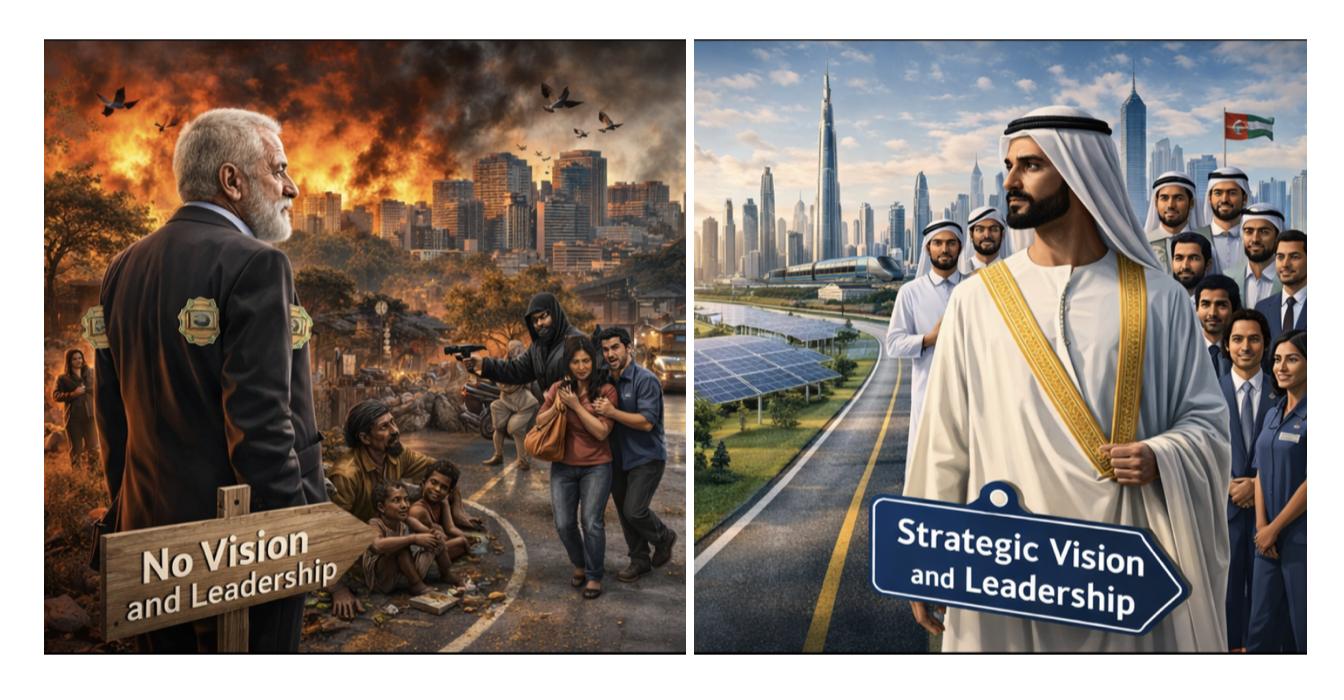
IMAGE: On the left, an ordinary city in Brazil – a country extremely rich in natural resources: a scene of urban insecurity, where citizens are being robbed, while a politician – symbolizing the elites of the three branches of government, benefiting from high salaries and numerous privileges – observes the situation without vision, focus, or leadership in service of the nation.
On the right, Dubai, in the United Arab Emirates – a largely desert country with evident natural limitations: an environment of order, development, and security, where a leader with strategic vision and a results-oriented approach is followed by confident citizens, reflecting a society that offers balanced, stable, and secure living conditions in multiple aspects.
The contrast is clear: on one side, an abundance of resources undermined by poor governance, which has failed to realize its full potential; on the other, natural scarcity transformed through planning, strategy, and effective leadership into remarkable economic and social development within just a few decades.
______
My reflection on Brazil and the United Arab Emirates (UAE) began not as an abstract academic exercise, but from personal curiosity. After reading works on the leadership philosophy of Sheikh Mohammed bin Rashid Al Maktoum, ruler of Dubai, I began to question how a country with such limited historical advantages could transform itself so rapidly into a global center of development.
To better understand this, I traveled to Dubai, Sharjah, and Abu Dhabi. What I encountered was not only visible wealth, but a functioning system shaped by clear vision, strong leadership, and consistent execution.
This experience made a comparison with Brazil – my reference point – inevitable.
Two Starting Points: Advantage vs. Absence
The UAE, until the 1970s, consisted largely of:
- Small desert communities
- Trading and fishing settlements
- Minimal infrastructure
- No significant legacy of scientific, philosophical, or industrial development
It had no deep historical foundation in modern state-building, no industrial revolution, and no long-standing institutions of higher education comparable to Europe.
Brazil, on the other hand, began its sovereignty in 1822 with enormous advantages:
- Continuous and direct contact with Europe
- Access to European science, philosophy, and education
- Exposure to the Industrial Revolution
- Vast natural resources and fertile land
=> Brazil had, for more than a century, access to the foundations of modern development that the UAE initially lacked.
Oil as Opportunity – and Leadership as the Multiplier
The discovery of oil gave the UAE a powerful starting point – but it was leadership that transformed this into long-term development.
Under leaders such as Sheikh Mohammed:
- Oil revenues were reinvested into infrastructure, education, and institutions
- A long-term vision focused on global competitiveness and future readiness
- The country actively attracted foreign talent and expertise
- Policies were implemented with speed and continuity
The UAE then moved beyond oil into:
- Tourism
- Aviation and logistics
- Finance and real estate
- Emerging sectors such as AI, data infrastructure, and aerospace
=> The key factor was not oil alone, but leadership capable of converting wealth into sustainable development.
Dubai’s Model: Opportunity, Safety, and Growth
A defining feature of Dubai is that it does not only attract professionals from around the world – it offers them:
- Personal safety and stability
- Clear economic opportunities
- Merit-based professional growth environments
People from diverse countries move there not only for higher salaries, but for:
- Predictable systems
- Efficient administration
- A sense that effort can translate into progress
This is particularly striking when contrasted with Brazil.
Brazil: A Country That Struggles to Offer the Same to Its Own Citizens
In Brazil, many citizens – especially those outside elite circles – do not experience the same level of opportunity, safety, or institutional reliability.
According to a brochure distributed by Estadão in 2024, around 67% of Brazilians aged 16 to 35 would consider leaving the country, citing:
- Corruption
- Limited economic opportunities
- Crime and insecurity
- Poor quality of public services
=> This reflects a profound lack of confidence – not from outsiders, but from Brazil’s own population.
While Dubai attracts global talent, Brazil struggles to retain its own.
A Nation Historically Built for Elites
A key factor behind this lies in Brazil’s historical development.
After the abolition of slavery:
- Formerly enslaved populations were not integrated
- Indigenous communities remained marginalized
- Economic structures continued to favor elites
At the same time, Brazil pursued a form of “Europeanization”, often valuing external models and populations over investing in its own.
The long-term consequences include:
- Persistent inequality
- Regional disparities, especially in the Northeast
- Limited social mobility
=> Development was not structured for the whole population, but disproportionately for elites.
The Absence of National Vision
Unlike the UAE, Brazil has rarely had leadership that pursued a coherent, long-term national vision.
Instead:
- Political cycles dominate decision-making
- Policies are fragmented and often reversed
- Leadership frequently serves short-term interests and elite groups
This results in:
- Weak execution of reforms
- Lack of continuity in development strategies
- Persistent institutional inefficiency
=> The problem is not a lack of ideas – it is the absence of consistent, nation-oriented leadership.
Corruption, Costs, and Structural Consequences
Corruption further deepens these issues, becoming part of a broader systemic pattern:
- Public resources are misused
- Infrastructure projects become inefficient and expensive
- Bureaucracy slows economic activity
To compensate, Brazil developed:
- High taxation
- High interest rates
These measures:
- Discourage investment
- Limit industrial growth
- Reduce competitiveness
This creates a vicious cycle: corruption → inefficiency → high costs → slow development → inequality.
A Giant That Never Fully Industrialized
Despite its size and resources, Brazil remains:
- Only partially industrialized
- Heavily dependent on commodities
- Limited in technological innovation
This contrasts sharply with countries that used their resources to build advanced economies.
Visible Consequences in Society
The structural failures translate into everyday realities:
- High poverty and inequality
- Elevated crime rates and insecurity
- Uneven and often poor education quality
- Weak public services
- Deficient transport and infrastructure systems
These are not isolated problems – they are the direct outcomes of historical exclusion, weak governance, and lack of long-term vision.
A Balanced Perspective: Structure Matters – But Leadership Decides
It is important to acknowledge that the UAE benefits from:
- Oil wealth
- A small citizen population
- Centralized governance
However, these advantages alone do not explain its transformation.
What distinguishes the UAE is:
- Strategic use of resources
- Openness to global talent
- Relentless focus on execution
Conclusion: A Tale of Leadership and Choices
The comparison between Brazil and the UAE is not about geography or destiny – it is about choices.
- The UAE started with almost nothing but built a modern nation through vision and execution
- Brazil started with immense advantages but failed to transform them into inclusive and sustained development
Brazil’s history reveals a pattern:
- Leadership aligned with elites
- Neglect of large parts of the population
- Absence of long-term national strategy
=> The result is a country that had everything necessary to succeed—but never fully mobilized its potential.
Until Brazil confronts:
- its legacy of exclusion
- its systemic corruption
- and its lack of consistent national vision
it risks continuing as what it has long been:
=> a nation rich in resources, but poor in execution.
Development is not defined only by what a country has, but by what it does with it – and for whom.