Brazil in the 1980s: Economic Crisis, Social Inequality, and Political Mismanagement – A Legacy of Suffering
In the 1980s, Brazil faced one of the most challenging periods in its history, marked by severe economic crises, political instability, and social turmoil. During this decade, the country was grappling with one of the largest foreign debts in the world, a situation exacerbated by mismanagement and an economic system that was increasingly unsustainable. Brazil’s foreign debt was a ticking time bomb, pushing the country to the brink of collapse, while its contribution to the global GDP remained below 1%. Hyperinflation became the defining feature of the Brazilian economy during this time, reaching a staggering 1782% in 1989. As the economy faltered, the gap between the wealthy elite and the poor masses widened, leaving the majority of Brazilians to suffer in silence, while the government continued to protect the interests of those in power.
Economic Collapse and Hyperinflation
The Brazilian economy in the 1980s was characterized by an overwhelming foreign debt and hyperinflation that decimated the purchasing power of its citizens. Brazil’s foreign debt was a massive burden, one of the largest in the world, and the country’s contribution to the global GDP was minimal, less than 1%. Inflation spiraled out of control, with prices rising at an exponential rate, and by the end of the decade, Brazil’s annual inflation rate had reached an astronomical 1782%. This hyperinflation created an atmosphere of economic chaos, eroding the value of money almost daily, leaving people unable to afford even the most basic necessities.
The crisis was particularly severe in the Northeast region, which was already one of Brazil’s poorest areas, where persistent droughts further aggravated the suffering of the population. The government’s inability to manage the economic crisis compounded the situation. Instead of addressing the systemic issues that led to the crisis, the government continued to serve the interests of the elites and the powerful sectors of society, while ordinary citizens were left to fend for themselves in a rapidly collapsing economy.
Political Corruption and Elites‘ Immunity
While ordinary Brazilians were sinking into poverty, those working for the government – the military, political elites, and their families – were largely insulated from the consequences of the crisis. In fact, many of these individuals saw their benefits substantially increase, a stark contrast to the deepening poverty faced by the general population. Widows of governors and military officers, for example, continued to receive generous pensions, despite the fact that their husbands were no longer in service. This was emblematic of the political culture in Brazil at the time, where the elites were able to protect their own interests while the majority of the population was left to suffer.
The political class in Brazil was deeply entrenched in a system of patronage, corruption, and self-preservation. Rather than taking meaningful action to address the root causes of Brazil’s economic crisis, the elites ensured that they remained secure. They continued to enjoy significant privileges, even as the majority of the population faced extreme hardship. This system of protection and privilege allowed the elites to weather the storm of hyperinflation and economic collapse while the Brazilian working class struggled to make ends meet.
Social Consequences: Crime, Poverty, and Despair
The social consequences of the economic crisis were devastating. With inflation spiraling out of control and wages unable to keep up, people were left with no way to support themselves or their families. Basic goods such as food, medicine, and clothing became increasingly expensive, and many Brazilians had to rush to markets to buy essential items before the prices rose even higher during the day. This created a sense of panic and instability in the population, as people struggled to survive in an environment where their savings were losing value almost daily.
The crisis pushed many families into extreme poverty. Desperation set in, and some resorted to measures such as prostitution and crime as survival mechanisms. In the worst cases, families were driven to suicide as the weight of poverty became unbearable. The government’s lack of leadership and vision exacerbated the situation, as it failed to implement meaningful social programs that could alleviate the suffering of the people. Instead of focusing on addressing the country’s structural issues, the government continued to support a political and economic system that served the interests of the few, while neglecting the needs of the many.
Sexual Tourism and Exploitation of Brazil’s Image
During this period, Brazil also became known internationally for its sexual tourism industry, which further highlighted the disconnect between the government’s actions and the needs of its citizens. The government, particularly in the tourism sector, capitalized on Brazil’s image of sensuality, using the country’s women as a marketing tool to attract foreign investment and tourism. This focus on exploiting Brazil’s image for economic gain further undermined the country’s social fabric, as it reduced the complex realities of Brazilian society to superficial stereotypes.
The fact that the government relied on sexual tourism to generate revenue reflected the broader failure of political leadership to address the country’s structural issues. Instead of empowering the population and creating sustainable economic opportunities, the state resorted to easy money, drawing attention away from the country’s real problems. This exploitation of Brazilian women also reinforced the notion that the poor, particularly in the Northeast, were disposable and of little value to the state.
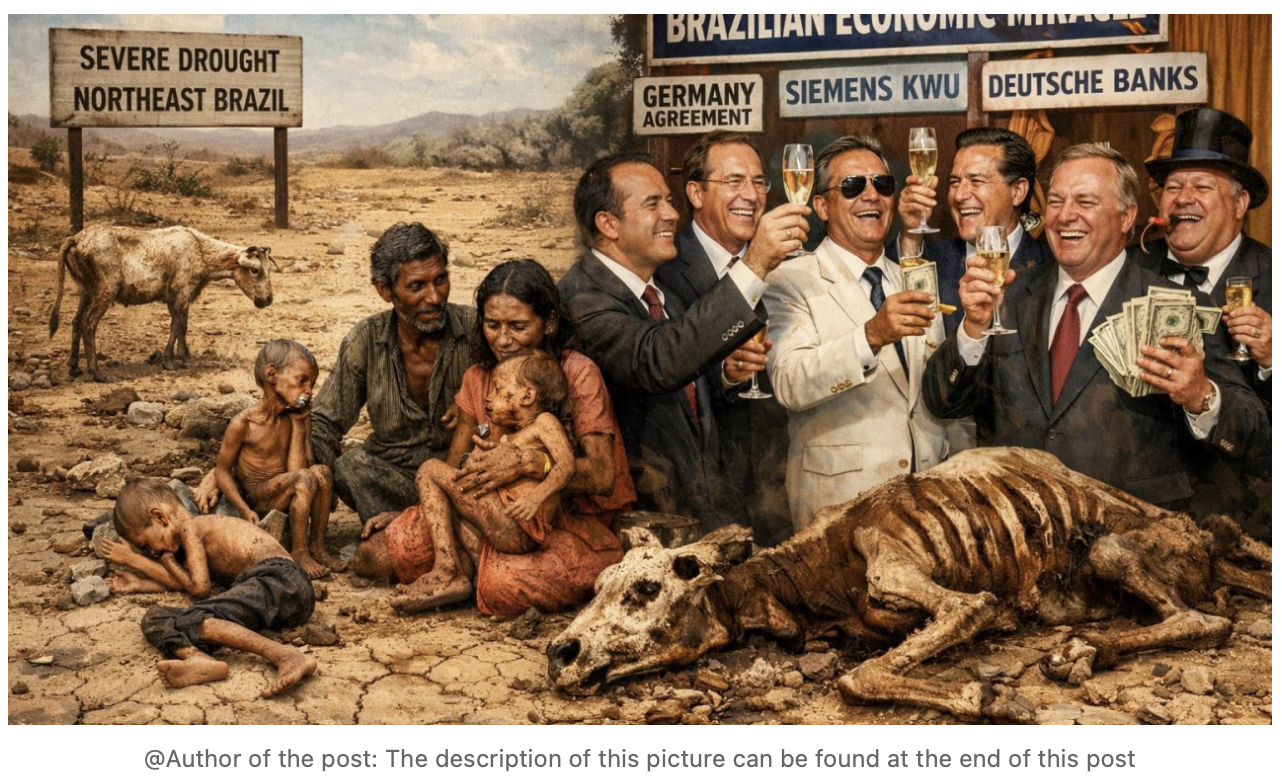
Germany and Brazil: The ‚Deal of the Century‘ That Left Brazil Paying the Price
The Brazilian ‚Economic Miracle‘ (1968-1973) was marked by rapid GDP growth exceeding 10% per year, driven by heavy external borrowing and high international liquidity. While this financing model fueled short-term economic expansion, it led the country to a rise in external debt, which reached around US$ 17 billion by 1974, leaving Brazil vulnerable to external shocks and fiscal imbalances for decades.
In 1974, while the giant and wealthy Brazil had a nominal GDP of approximately US$ 109.8 billion, West Germany, a country 34 times smaller than Brazil, with a tiny domestic market, far fewer natural resources for its massive industrial production, and freshly devastated by the Second World War that it itself had caused, had already recovered and surpassed Brazil with a nominal GDP exceeding US$ 400 billion per year (on its way to becoming the third-largest economy in the world at the time). Germany also secured its largest post-war industrial project in 1975, ironically with the heavily indebted Brazil: the nuclear agreement, known as the ‚Deal of the Century.’The agreement called for the construction of eight nuclear power plants in Brazil and the complete transfer of uranium enrichment technology. However, the project is widely considered a strategic failure for Brazil. For Germany, it was an immediate commercial success for companies like Siemens (KWU), helping to consolidate its heavy industry in the post-war era. For Brazil, the outcome was a heavy debt burden and an incomplete nuclear program.
Germany saw Brazil as an extension of its market: an opportunity to profit from the transfer of nuclear technology, with industrial and financial gains at any cost. The deal provided German industry and banks with an export market and profits while transferring experimental nuclear technology that proved industrially inviable and energy-inefficient for Brazil.
The so-called „economic miracle“ in Brazil was, in reality, a mirage – a facade built at the expense of the working class and the poor, who endured the long-term repercussions of economic policies focused on short-term growth rather than sustainable development. Ultimately, this approach led to an economic collapse, leaving Brazil in a far more precarious position than before
However, this was further exacerbated by what came to be known as the „Deal of the Century.“ The deal provided German industry and banks with an export market and profits while transferring experimental nuclear technology that proved industrially inviable and energy-inefficient for Brazil. Brokered by General Geisel, a Brazilian of German descent, this agreement with Germany brought even more disaster for the Brazilian people. Germany’s involvement in the nuclear deal with Brazil can be seen as ignoring the country’s poverty and financial instability, contributing to its worsening situation.
The deal, while advantageous for Germany’s industrial companies and its banks, is often seen in Brazil as a prime example of how wealthy, supposedly friendly nations, through their dealings with poorer countries, can inadvertently exacerbate existing problems rather than offering meaningful solutions. Brazil’s economic collapse in the 1980s can, in part, be traced to the mounting debts and unfinished projects resulting from deals like this one, which only deepened the country’s financial instability.
In the end, Brazil cannot complain when it made such deals. It was aware of both its own interests and the economically imperialistic intentions of some „friends.“ Their leaders were securing profitable deals for their people. And the Brazilian leaders accepted the deal for what reasons, while ignoring the suffering of millions of Brazilians?
Since the 1980s, while consumption levels improved, Brazil’s class structure worsened during the so-called „lost decade“ and has changed little since. According to a 2018 OECD study, it takes, on average, 9 generations for a low-income family in Brazil to reach the country’s average income. In contrast, this process takes only 6 generations in Germany, with each generation experiencing a cycle of nearly 250 years.
Conclusion: A Legacy of Failure
The 1980s in Brazil were marked by economic mismanagement, political corruption, and social decay. The country’s foreign debt, hyperinflation, and political instability created a perfect storm, devastating the lives of millions of Brazilians. While the elites remained insulated from the worst effects, the majority of the population was left to suffer. The government’s failure to provide effective leadership and address the country’s real problems only deepened the crisis, leading to a vicious cycle of poverty, inequality, and social unrest that would persist for decades.
The Brazilian state’s inability to meet the needs of its people during this period left deep scars on the country’s social and political fabric. Despite ongoing efforts to reform, Brazil continues to grapple with the same fundamental issues that plagued the 1980s. The lessons of this decade – the importance of strong leadership, vision, and sustainable economic policies – remain critical today as Brazil continues to face its enduring challenges in the 21st century.
While official statistics from the period are often incomplete or were suppressed at the time, historians and researchers have estimated the human cost of the economic and climate crises in Northeast Brazil during the 1970s and 1980s:
- Excess Deaths during the „Hunger Crisis“ (1979–1984): Research and social organizations like ASA (Articulação no Semiárido Brasileiro) estimate that between 700,000 and 1 million people died in the Northeast due to a combination of severe drought and the failure of public policy during the debt crisis.
- The „Silent Genocide“: At the height of the crisis in 1983, reports from state governments in the region indicated that roughly 100 people were dying per day from hunger-related causes.
- Child Mortality: The Northeast bore the brunt of Brazil’s high infant mortality rates. In 1970, the national infant mortality rate was roughly 120 deaths per 1,000 live births, with rates in the impoverished Northeast significantly higher. By 1980, while the national average dropped to 69 per 1,000, the Northeast remained the most vulnerable region due to lack of sanitation and healthcare.
- Impact of the „Economic Miracle“: Ironically, some studies suggest the „Economic Miracle“ (1968–1973) actually saw a rise in infant mortality in certain urban areas of the Northeast because the focus on industrial growth ignored basic sanitation and led to the „selective neglect“ of marginalized populations
__________
Em 1940 a indústria brasileira representava somente 0,4% do produto industrial do mundo, alcançando 3,2% no ano de 1980. A partir daí, o movimento de queda na industrialização tem se mantido. Em 2012, a indústria no Brasil representa 1,7% do produto industrial do mundo, o equivalente a participação verificada na década de 1960.
Fonte: Brasil sem industrialização a herança renunciada. Marcio Pochmann. Pag 13. Ponta Grossa: Editora UEPG, 2016, 187 p. ISBN 978-85-7798-216-5
__________
Picture description: In this fictive picture, on one side, Brazilian leaders from the three branches of our democracy and business people are seen celebrating alongside German industrialists and politicians, seemingly united in their success.On the other side, however, a stark contrast unfolds: Brazilian families are struggling in their daily lives, with hunger and poverty etched on their faces, while the corpses of animals, who died in search of food, lie scattered. The image captures the stark disparity between the elite’s celebratory moment and the widespread suffering of ordinary Brazilians, highlighting the dissonance between political triumphs and the harsh realities faced by the nation’s people.