
Another Life Lost – What Brazil’s Violence Says About Its Institutions
Another innocent life lost in Brazil, in a city that has become internationally associated with violence: Rio de Janeiro.
Andréa Marins Dias, a respected 61-year-old doctor, was killed during a police chase and shootout in the city. She was not involved in crime. She was simply in the wrong place at the wrong moment.
Behind this tragedy lies a story that is tragically common in Brazil. A person studies, works, contributes to society, pays taxes, and hopes to one day enjoy a peaceful retirement. Yet the state often fails to guarantee the most basic right of all: personal security.
This raises a fundamental question: when citizens do everything society expects from them – study, work, contribute – should they not at least be able to trust that the state will protect their lives?
The Numbers Tell the Story
=> Brazil has one of the highest homicide totals in the world.
=> In recent years, around 90–110 people are murdered every day in Brazil.
=> To understand the scale of this problem, comparison is essential.
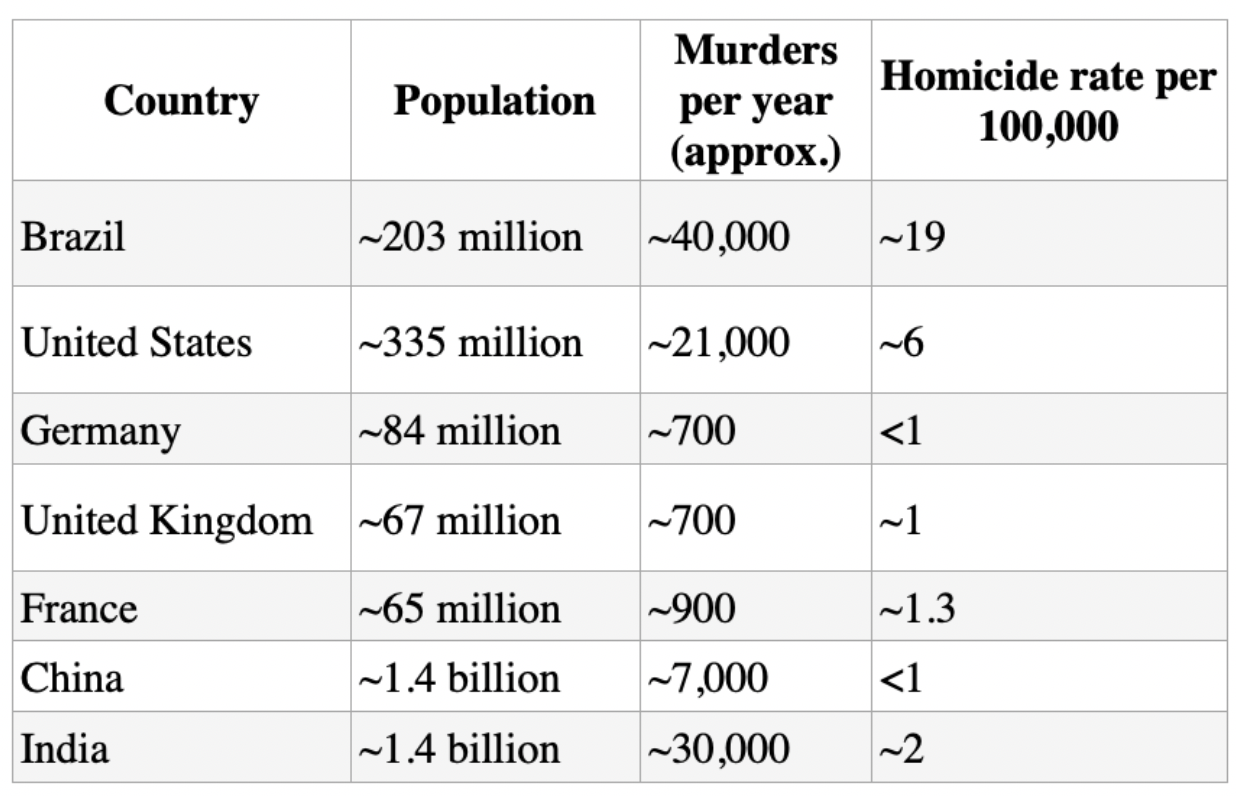
Brazil therefore records far more murders than countries with much larger populations. Within the BRICS countries, only South Africa shows similarly high levels of violence.
However, South Africa’s situation is often associated with the deep social inequalities created during decades of apartheid. Brazil, by contrast, did not experience such a historical system of racial segregation and institutional division.
Despite this, Brazil continues to struggle with levels of violence more comparable to conflict zones than to emerging economic powers.
Violence Is Also an Economic Problem
Crime does not only destroy lives – it also damages economic development.
Tourism provides a striking example. Major cities around the world attract enormous numbers of international visitors each year:
- London: about 20 million international tourists
- Dubai: more than 17 million
- New York City: around 13 million
- Beijing: about 10–11 million
- Lisbon: about 6–7 million
- Cape Town: roughly 2–3 million
- Delhi alone: around 6–7 million international tourists
By comparison, the entire country of Brazil receives only around 6 million international tourists annually. So Delhi in India roughly receives about the same number of international tourists as the entire country of Brazil
Why this is striking
Brazil has:
- the Amazon rainforest
- world-famous beaches
- Rio de Janeiro, Salvador, Recife, Manaus
- Iguazu Falls
- huge biodiversity
- global cultural appeal
Few countries in the world possess such tourism potential. Yet insecurity continues to undermine Brazil’s ability to benefit from it.
Violence Without War: Brazil’s Homicide Rate Compared to the World
The scale of violence in Brazil becomes clearer when compared internationally.
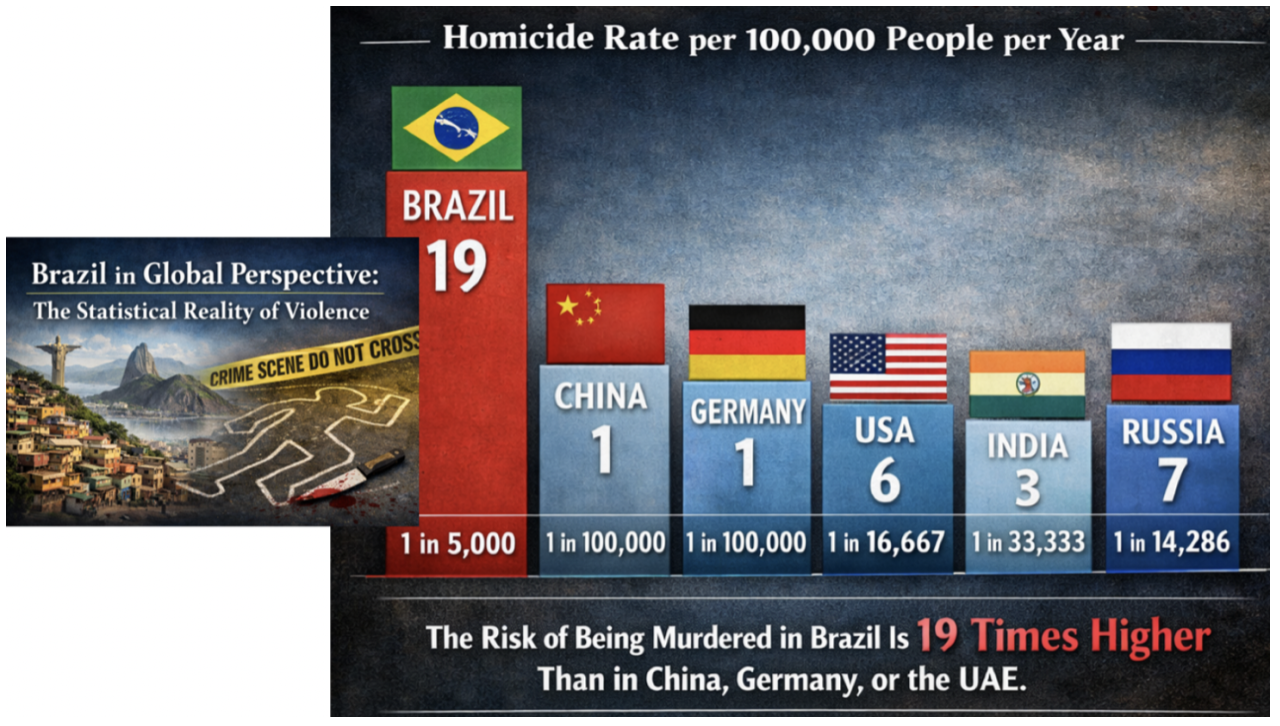
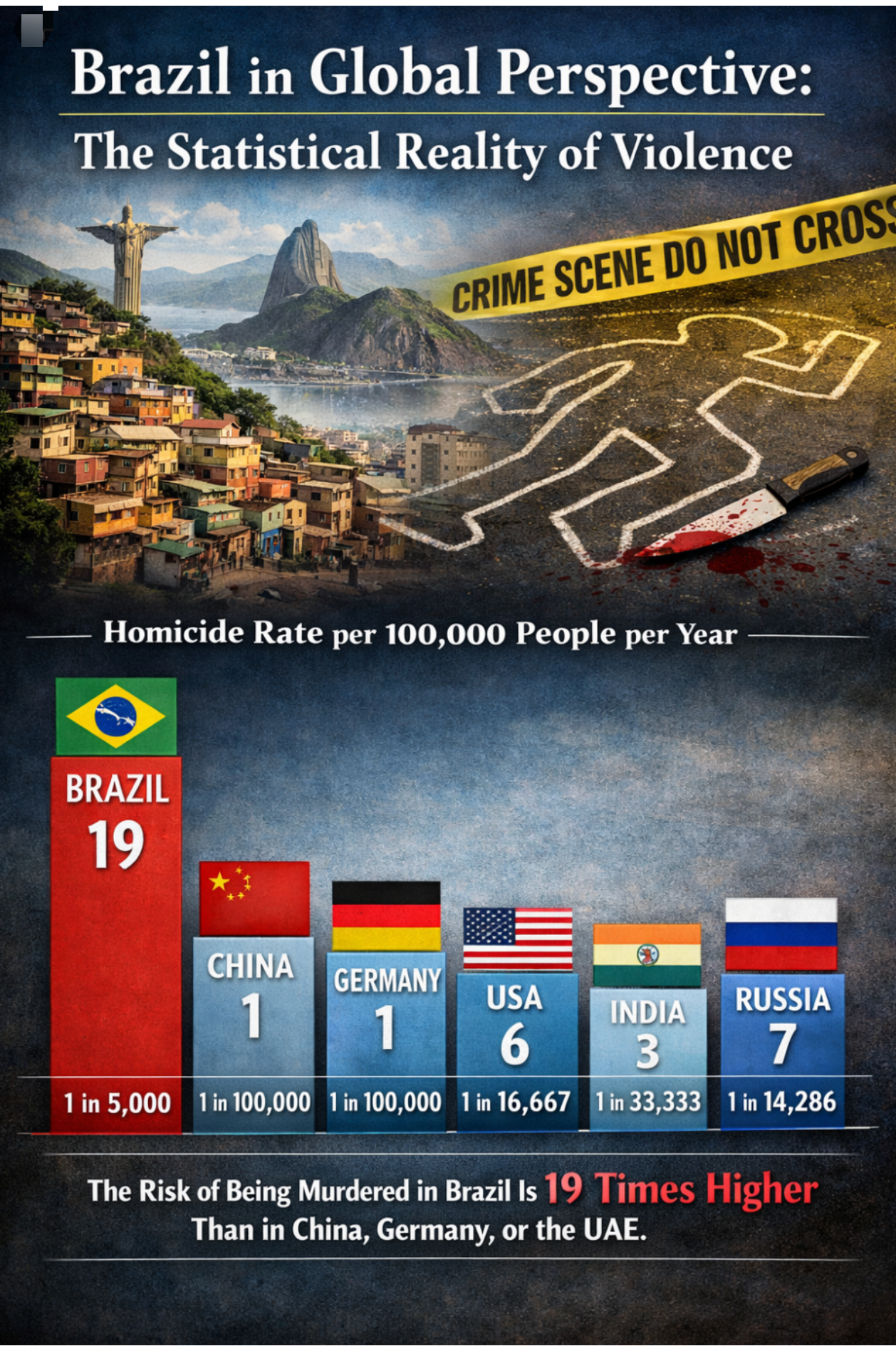
There is no good international dataset for “being murdered on a street” specifically. The closest comparable measure is the national intentional homicide rate per 100,000 people per year. That is an annual average risk across the whole population, not a street-only risk. Based on the latest World Bank / UNODC figures, here is the comparison:

Using this broad homicide measure, the annual risk in Brazil is roughly:
- 19 times higher than in China, the UAE, Germany, or Poland
- about 3 times higher than in the USA
- about 6 times higher than in India
- about 2.7 times higher than in Russia
Important caveat
This is a national average, so it can hide huge differences:
- by city
- by neighborhood
- by sex and age
- by whether deaths are linked to organized crime, police violence, domestic violence, or other causes
So it does not mean that every person walking on a street in Brazil faces the same risk everywhere. But as a broad international comparison, Brazil’s homicide burden is clearly much higher than the countries you listed.
Organized Crime and the Weak State
Brazil’s violence is not only the result of individual crime. It is closely connected to the rise of powerful organized criminal groups. Major organizations such as PCC (Primeiro Comando da Capital) and Comando Vermelho emerged largely inside Brazilian prisons during the 1980s and 1990s – a period when millions of Brazilians and their families were struggling to survive the severe economic consequences created by corruption, mismanagement, and the failures of all three branches of Brazil’s so-called democratic system.
In this context, the state itself contributed to the creation of these criminal structures. Severe economic crises pushed many Brazilians toward criminality as millions of citizens struggled simply to survive. While the elites within the three branches of government accumulated wealth, power, and privileges, large parts of the population were left alone to face the consequences of decades of economic instability, corruption, and mismanagement.
This situation led to overcrowded prisons, weak institutions, and corruption within the prison system itself. At the top of society stood protected political and institutional elites, while at the bottom many ordinary Brazilians were left without opportunities, security, or support. In such conditions, some slipped into criminality, others into prostitution and exploitation.
Even public policies have sometimes contributed to the distortion of Brazil’s image abroad. For years, tourism campaigns promoted internationally the sensual image of Brazil’s beaches and the bodies of young women, reinforcing stereotypes and attracting a form of tourism that treated the country as a playground rather than as a serious society striving for development.
Through Embratur, millions of public funds – money Brazil could hardly afford – were spent promoting this image instead of presenting the country’s true cultural, scientific, and economic potential.
A lack of long-term vision, constant improvisation, and the pursuit of private advantage have too often characterized the actions of Brazil’s political and institutional elites. To this day, the three branches of government – the executive, legislative, and judicial branches –frequently operate without coherent national planning, while ordinary citizens continue to bear the consequences of these failures.
Brazil must recognize its own role in the development of the situation it faces today. Without acknowledging how political decisions, economic crises, and institutional failures helped create these conditions, it will be difficult to confront the roots of organized crime and social insecurity.
Over time, these groups developed into powerful national criminal networks involved in:
- drug trafficking
- arms trafficking
- extortion and protection rackets
- territorial control in urban areas
Today, in many parts of Brazil – especially in poor urban neighborhoods – criminal organizations exercise authority and control that should belong to the state. In practice, they often govern territories where the state has failed to provide security, order, and justice.
Corruption and Governance
Violence does not grow in isolation. It flourishes where institutions are weak.
Brazil has struggled since 1889 with corruption scandals involving political actors, public institutions, and large public contracts. At the same time, political and institutional elites within the executive, legislative, and judicial branches have secured extremely high salaries, benefits, and protections. Many scholars argue – and my own experience in Brazil confirms – that corruption in the country is not merely the result of individual wrongdoing. It is largely the product of institutional incentives created by political fragmentation, patronage networks, complex bureaucracy, and the pressures of campaign financing. In practice, Brazil’s political system – although democratic in form – often operates in ways that structurally reproduce corruption.
Meanwhile, many ordinary citizens face:
- insecurity
- economic pressure
- limited protection from violence
When institutions that should fight corruption are themselves perceived as benefiting from the system, public trust inevitably erodes.
Democracy and Responsibility
Democracy is not defined only by elections.
It is defined by the ability of institutions to protect the lives, rights, and dignity of citizens.
A country rich in natural resources, culture, and human talent should not be known for violence. It should be defined by the capacity of its institutions to protect the lives and dignity of its citizens.
The Human Cost
Statistics can make violence seem abstract.
But behind every number stands a human life.
- A family.
- A career.
- A future that will never happen.
The death of Andréa Marins Dias is not only a personal tragedy. It is also a reminder of a deeper institutional problem.

Imagem: Todos os direitos autorais pertencem ao Estadao: https://www.estadao.com.br/brasil/medica-morre-troca-de-tirospoliciais-criminosos-zona-norte-
What Brazil’s Violence Says About Its Institutions?
Brazil is a country of immense wealth in natural resources, culture, and human potential. Yet it has never developed itself in a way that corresponds to this richness, and it remains far from the level of prosperity it could provide for its population.
For decades, the elites within the three branches of government – the executive, legislative, and judiciary – have been able to benefit from the country’s resources regardless of the broader economic situation. Even during periods when Brazil depended heavily on foreign credit or suffered extreme economic crises, such as the hyperinflation of the late 1980s and early 1990s, which exceeded 1,000% per year, these elites proved remarkably effective at preserving their privileges. In contrast, most Brazilians were left exposed to the severe consequences of economic instability, weak governance, and institutional failures. The result is a painful paradox: a nation rich in potential, yet unable to translate that wealth into security, stability, and prosperity for the majority of its citizens.
In the end, the tragedy of Brazil is not the lack of resources or human potential, but the persistent inability of its institutions to transform this wealth into security, dignity, and opportunity for the citizens who sustain the nation.