
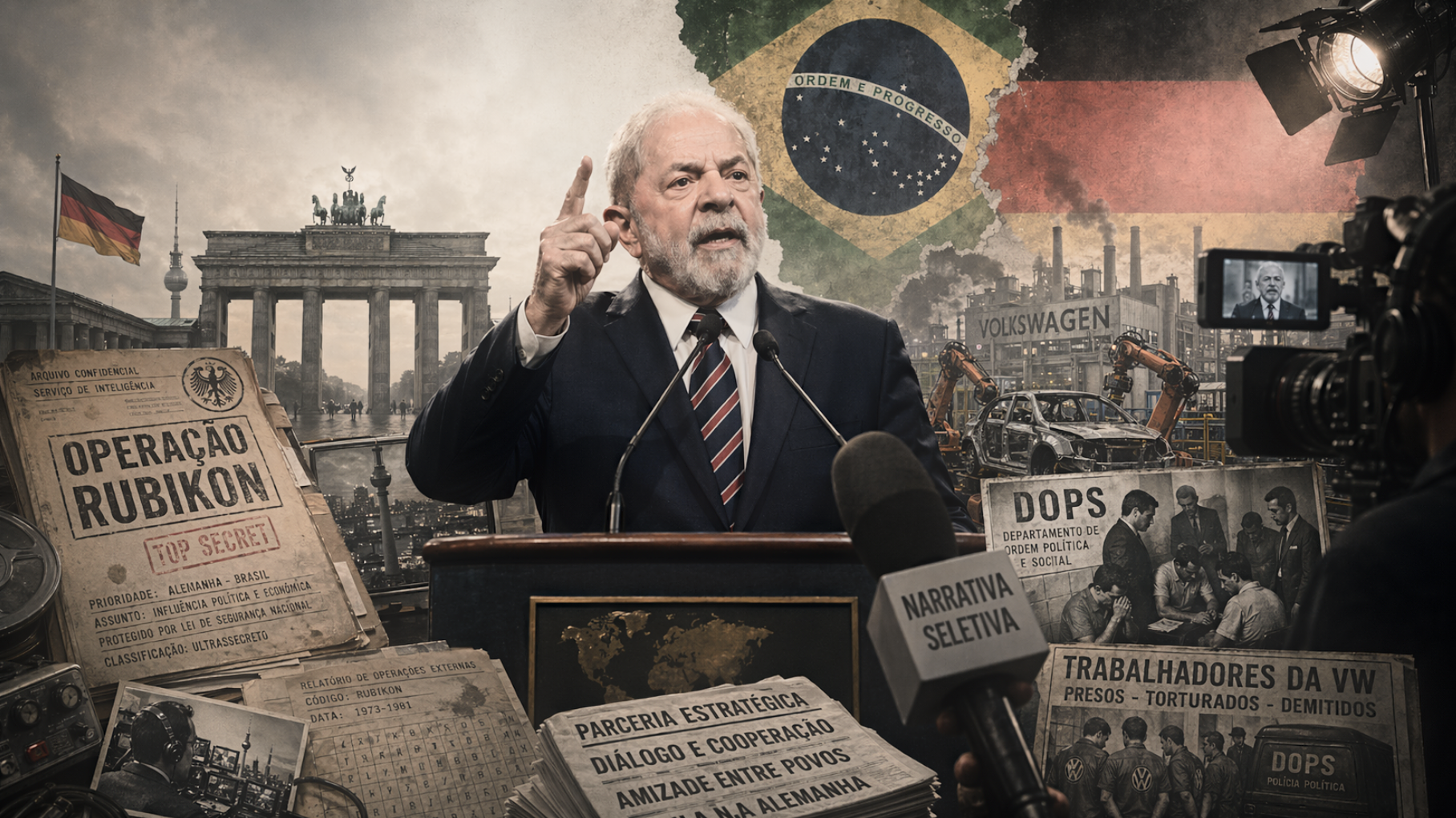
Germany, Lula, and the Return of Selective Morality
Lula was interviewed 21.04.2026 by the German state broadcaster ARD, but the issues that truly expose Brazil’s degradation were simply ignored. Nothing about the corruption that reaches even the Supreme Court, his son and his brother, nothing about the weakening of democratic institutions, nothing about human rights in Brazil, nothing about urban violence, nothing about the devastation of the Amazon. All of these subjects were an obsession for the broadcaster and many others in Germany when Bolsonaro was in power. Now, under Lula, they have disappeared from the agenda. This lays bare a shameful selectiveness. With Lula in power, ARD no longer shows any real concern for the true destruction of Brazilian democracy.
The interest at the moment is another: to attack the United States, even if Lula must be instrumentalized for that purpose. The Germans are upset with the U.S. because the Americans no longer behave like obedient partners of the G7 bloc. And, since Lula has entered into confrontation with Trump, Germany takes advantage of this activism to convey, indirectly, the message that even Brazil rejects Trump. This is blatant opportunism. Germany, on its own, does not have the courage to confront the United States directly; so it makes use of convenient actors to do so by proxy.
Lula, for his part, appreciates this role. He likes to be applauded, flattered, and elevated by the great centers of power. And now that the United States and Israel support his political enemy, Bolsonaro, he intensifies his activism on German territory, enthusiastically offering himself to this game of convenience. His posture does not reveal greatness, but political vanity and a willingness to serve interests that are not always Brazil’s. No German chancellor would ever behave like Lula; the history of relations between the two countries shows that Germans defend their land and their interests with every means at their disposal, even through the culture of Volkstum. Germany has always been determined to preserve its greatness at any cost, even in and through the countries of its business partners.
What stands out most in this report is seeing Germany repeat, without embarrassment, the same logic that marked its conduct during the Brazilian military dictatorship: economic interest above any moral scruple. At that time, what mattered was the profit obtained in Brazil with the backing of the military. Today, the logic seems the same, only dressed up in more sophisticated language.
When it was aligned with the United States, Germany took part in espionage against Brazil for more than twenty years, in the largest spying project in its history: Operation Rubikon. At the same time that it was exploiting Brazil in multiple ways and helping to deepen the suffering of the population, Volkswagen was cooperating with the police who tortured Brazilian workers. VW went so far as to hire a former Nazi to do the dirty work of spying on its own employees in Brazil and handing them over to police repression. And, in the same period, Germany also concluded its largest postwar industrial agreement on terms unfavorable to Brazil. Siemens was involved both in the espionage project and in the industrial-nuclear project.
In light of this, it is astonishing that Lula chose to visit Volkswagen of all companies. Germany has in Brazil its largest industrial park outside German territory, yet he preferred to give visibility precisely to the company that carries this dark past. This is neither an innocent nor a trivial gesture. It is a symbol. And, as a symbol, it says a great deal about the kind of political and economic alliance that is being cultivated: an alliance founded not on the dignity of the Brazilian people, but on the convenience of elites, on diplomatic cynicism, and on the old logic of exploitation disguised as partnership.