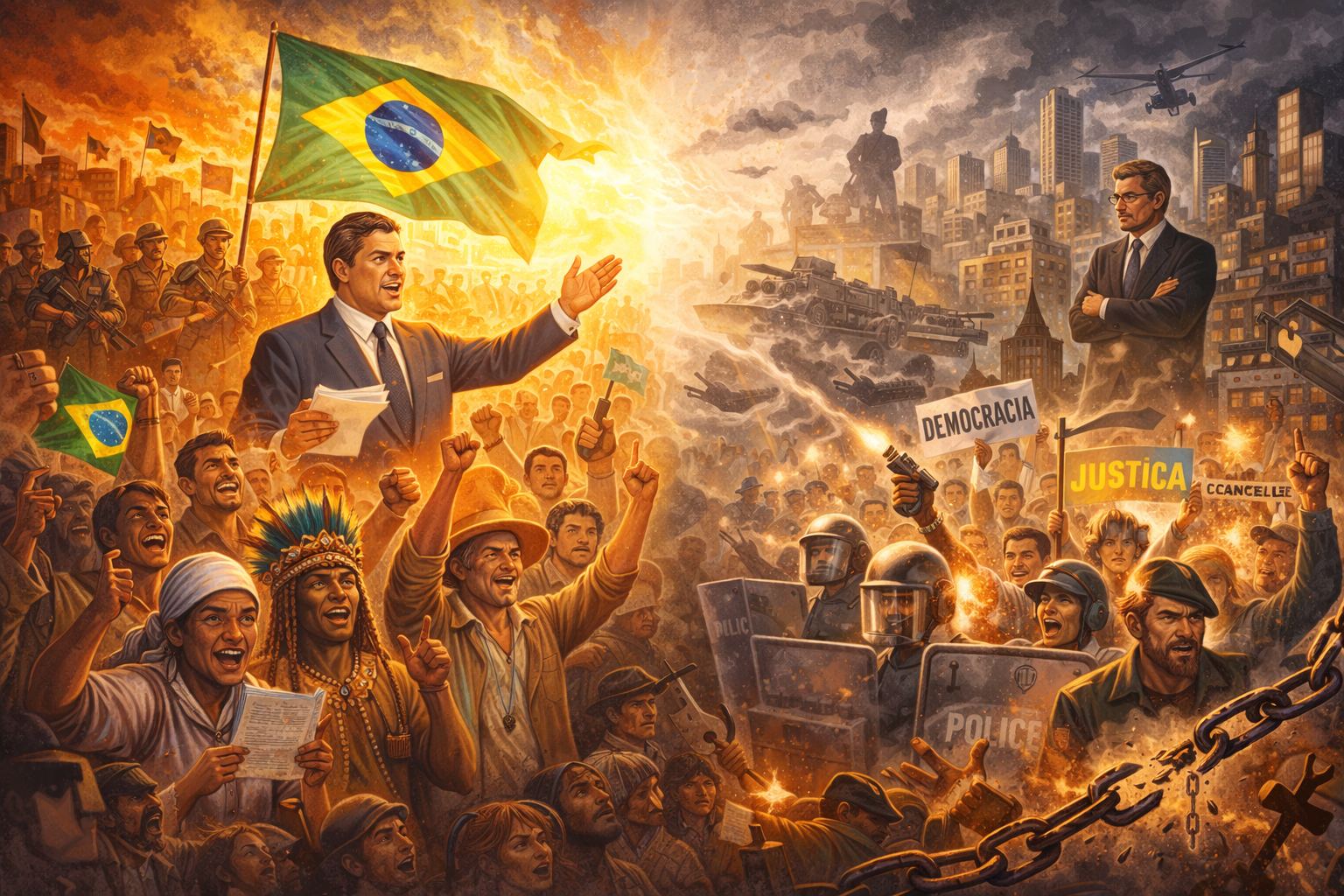
Brazil: Between the Democratic Yearning and the Persistence of Inequalities – The True Coup Against Democracy, Which Has Yet to Recover
The brutal suppression of the democratic and social reforms that began in the 1960s contributed to the persistence of deep inequalities and social injustice in Brazil. Today, the country still suffers the consequences: ongoing attempts at exclusion – sometimes echoing in the Southeast toward the Northeast, rooted in government-led Europeanization that reinforced the Northeast’s social and economic exclusion – extreme corruption, disproportionate salaries for politicians, and millions earning far less than those in power. This history demonstrates that true democracy requires not only institutions, but also inclusion, accountability, and the protection of social justice.
In the 1960s, illiterate Brazilians were prohibited from voting. The majority of this population was concentrated in the Northeast – a region that gave rise to Brazil and its first sources of wealth, but which, over time, was increasingly marginalized by modernization and Europeanization policies implemented during both the monarchical and republican periods. This process had profound consequences, the effects of which persisted for decades.
It was the beginning of the 1960s: the world was once again at peace and focused on economic and social progress. Brazil, in its Fourth Republic, was struggling to strengthen its democracy, while countries with far less development potential – such as West Germany, now a democratic state. Brazil, however – despite its wealth of natural resources – remained underdeveloped, marked by extreme inequality and the systematic exclusion of a large part of its population from opportunities for education, work, and full citizenship, falling far short of the economic and social progress expected since it became a sovereign country in 1822.
At that time, a Brazilian president sought to change this reality in a country that was a giant by its very nature: João Goulart. In a message sent to the National Congress in March 1964, he stated: “Considering that more than half of the population is illiterate, one can assess the weight of this injustice. The electorate no longer represents the nation.”
The exclusion of illiterates from the electoral process had deeper historical roots. In 1881, the Saraiva Law, approved by the Chamber of Deputies and the Senate of the Empire under Dom Pedro II, established literacy as a requirement for voting. In 1879, the then Minister of Justice, Lafayette Rodrigues Pereira, justified this stance: „- Ignorance, because it is widespread, acquires the right to govern? If eight-tenths of the Empire are illiterate, I would say they must be governed by the two-tenths who can read and write.“
The project that led to the Saraiva Law was drafted by Ruy Barbosa, who argued that slaves, beggars, and illiterates should not vote, considering them incapable of discerning the common good. Yet the political elites of the time did not make significant investments in educating this large portion of the population, which could have expanded their participation in national life.
Instead, throughout the late 19th and early 20th centuries, the country prioritized and expanded policies aimed at European immigration, especially to the South and Southeast, in order to meet the economic demands of these regions. This process contributed to deepening pre-existing regional inequalities, leaving large contingents of the population – especially in the Northeast – marginalized from development and subjected to precarious working conditions.
————— Aside —————-
The idea of “Europeanization” – understood as whitening and modernization according to European models – did not emerge as a single, formalized plan, but gained momentum mainly from the second half of the 19th century. This process intensified around the 1870s, still during the late Empire under Dom Pedro II, and continued with even greater intensity during the First Republic, especially until 1930.
In the 1870s, among the Brazilian elites, the perception grew that the country needed to “modernize” according to European models. These elites began to Europeanize the South and Southeast regions and to adopt racial theories imported from Europe – now discredited – which associated progress with the white population. While the state encouraged European immigration, these ideas became firmly established in the thinking of the dominant classes, an environment already fertile for them.
After the abolition of slavery in Brazil, the elites faced the challenge of reorganizing labor. Instead of promoting the integration of the country’s original populations – former enslaved people, Northeastern communities, and Indigenous peoples – through structural policies such as widespread education and agrarian reform, they chose to encourage European immigration. This decision was driven by prejudice, based on the idea that the existing Brazilian population was “inferior” and suited only for work in the fields or in the homes of the wealthy.
Between 1880 and 1930, the Brazilian state financed the arrival of millions of Europeans, directing them mainly to the South and Southeast. However, those who arrived and the culture they brought further deepened the segregation between the society they formed and the majority of Brazilians, who already spoke Brazilian Portuguese, had a Brazilian culture, and were now excluded from the goals of national progress.
————— End of Aside —————-
Thanks to new technologies, especially from the beginning of the 21st century, Brazilians — even in the most underdeveloped parts of the country – have sought to understand why, despite owning a nation so vast and rich in natural resources, they still have access to precarious public services in infrastructure, health, education, and security.
This curiosity leads them to reflect on how they were educated and to question the content and perspectives received throughout their schooling. In this process, they move from simple questioning to active contestation.
Even universities, which at other times often reproduced views aligned with the interests of the dominant classes, began expanding research and publications with greater autonomy from elitist influences. This movement contributes to a broader and more critical understanding of historical facts.
One such fact is the fall of João Goulart’s government, which advocated for the expansion of democracy and the implementation of structural reforms in pursuit of greater social justice.

On March 13, 1964, Goulart delivered a public speech that alarmed the elites. He firmly defended a more inclusive democracy, speaking of structural reforms such as land reform, tax reform, the right to vote for illiterates, and the eligibility of all Brazilians. Goulart emphasized the need to expand the political citizenship of urban and rural workers. This stance provoked a strong reaction from the elites, and just a few days later, on March 31, 1964, the military coup occurred:
„I address all Brazilians, not only those who have been able to obtain an education in schools. I also address the millions of our brothers who give more to Brazil than they receive and who pay, in suffering, misery, and deprivation, for the right to be Brazilian. […] It was proclaimed that this gathering would be an act threatening the democratic regime, as if the reaction still owned democracy. […] Wretched is the democracy if it must be defended by these so-called democrats. What they want is a democracy of a silenced people, suffocated in their desires and demands. […] The democracy they intend is the democracy of privileges, intolerance, and hatred. Our motto is progress with justice and development with equality.“
After the rally, the military conspiracy accelerated, supported by conservative sectors of civil society and with the backing of the U.S. government. As a result, the military used tanks, other war instruments, and soldiers to take control of the streets in major Brazilian capitals. Political offices, including the presidency, were effectively neutralized, and another dictatorship was established on March 31, 1964.
The 1964 coup was welcomed by significant sectors of Brazilian society. Much of the business community, the press, landowners, the Catholic Church, several governors of key states (such as Carlos Lacerda of Guanabara, Magalhães Pinto of Minas Gerais, and Ademar de Barros of São Paulo), and broad segments of the middle class requested and encouraged military intervention as a means to halt the “leftward drift” of the government and to control the economic crisis. The United States closely monitored the conspiracy and unfolding events, mainly through its ambassador in Brazil, Lincoln Gordon, and military attaché Vernon Walters, and had decided, via the secret „Operation Brother Sam,“ to provide logistical support to the coup forces if they encountered prolonged resistance from forces loyal to Goulart.
The 1964 coup interrupted the course of democracy in Brazil. However, the military rulers of the country from 1964 to 1985 constructed narratives to justify their actions as necessary measures: in a 1981 statement, the former Brazilian dictator, descendant of German immigrants, Ernesto Geisel, declared:
„What happened in 1964 was not a revolution. Revolutions are made for an idea, in favor of a doctrine.“
According to Geisel, the movement that established the military regime did not occur to promote a project for the country, but against João Goulart, against corruption, and against alleged subversion. Strictly speaking, the movement led by the Armed Forces, according to the military leader, was not aimed at building something new for Brazilians, but rather at defending the specific interests of the elites and maintaining the order that favored them.
In this context of repression, a striking contrast emerges: when Brazilians, outraged by their living conditions and the actions of the three branches of government, commit acts of vandalism against symbols or buildings associated with the elites – as occurred on January 8, 2023 – they are subjected to extreme repression, facing hefty fines and long prison sentences that provoke family and social destabilization, under the justification of defending democracy. The repression of January 2023 received media support and, indirectly, backing from European countries traditionally allied with Brazil since its sovereignty, such as Germany, which during the military dictatorship built in southern Brazil one of the largest industrial complexes of German companies outside Germany, concentrating investment, technology, and labor on a scale that no other country in the world – not even Germany itself – possessed outside its territory.
On the other hand, when members of Brazil’s political and institutional elites abuse their powers – whether by raising their own salaries above the constitutional ceiling, implementing mechanisms such as the secret budget, or creating favoritism networks involving family members in the judiciary – these practices are often tolerated or treated as part of “democratic” functioning.
The practices of the three branches of government, which have resulted in recurring corruption scandals across Brazil, combined with the lived reality of the majority of the population, reveal a deeply unequal country, where segments of the elite remain immersed in power structures marked by privileges and often repeated allegations of corruption. This scenario leads many Brazilians to revisit their history, trying to understand how a nation so rich can maintain such persistent levels of inequality.
The influence of historical legacies – including ideas associated with Europeanization and eugenics, the latter scientifically discredited – is still evident in cultural patterns in southern and southeastern Brazil. At the same time, internal and external economic interests have contributed, over time, to a development model that frequently favored the concentration of wealth and the maintenance of social inequalities.
Today, more than half a century after the coup that overthrew João Goulart, Brazil remains marked by deep inequalities. Wealth and power are still highly concentrated: around 93% of federal deputies belong to the richest 10% of the population, and approximately 18% can be considered ultra‑wealthy. While millions of Brazilians face inadequate public services, politically powerful individuals with vast assets often have their practices tolerated or normalized. This contrast shows that, although formal democracy exists, many of the same imbalances and privileges that Goulart challenged continue to shape the country. The memory of his fight for social justice and expanded citizenship serves as a call to reflect on how to effectively transform Brazil, confronting historical inequalities and rebuilding opportunities for all.
In light of this, a difficult question arises: transforming the country, whether within the democratic system or through other means, seems a profound challenge, given the complexity and entrenchment of these structures. Where, after all, will the agents capable of enacting real change come from?
- De Toledo, Caio Navarro. O Governo Goulart E O Golpe De 64. Editora Brasiliense. 1993.
1964 – Visões críticas do golpe: democracia e reformas no populismo”. Editora da Unicamp. 1997. - Gaspari, Elio. A Ditadura Derrotada. O Sacerdote e o Feiticeiro. Editora Companhia das Letras. 2003.
- De Almeida Neves Delgado, Lucilia. O Governo João Goulart e o golpe de 1964: memória, história e historiografia. https://www.redalyc.org/pdf/1670/167013403006.pdf
- O golpe de 1964 e a instauração do regime militar:
https://cpdoc.fgv.br/artigos/golpe-1964#:~:text=O%20golpe%20de%201964%20e%20a%20instaura%C3%A7%C3%A3o%20do%20regime%20militar. - 1964: A DEMOCRACIA GOLPEADA: https://www2.unicamp.br/unicamp/unicamp_hoje/ju/marco2004/ju246pag02.html
- March 13, 1964, Goulart delivered a public speech: https://www.youtube.com/watch?v=KjM48ZjevmA
- Documentary: https://www.youtube.com/watch?v=SaU6pIBv9f4
- Judt, Tony. Postwar: A History of Europe Since 1945. 2005.
- Blackbourn, David. German in the World. A Global History (1500 – 2000). 2023.
- Schulte, Frederik. Auswanderung als nationalistisches Projekt. 2016.
- Hell, Jürgen. Die Politik des deutschen Reiches nur Umwandlung Südbrasiliens in ein überseeisches Neudeutschland (1890 – 1914). Inaugural Dissertation zur Erlangung des Doktorgradesnder Philosophischen Fakultät der Universität Rostock, 1966.
- German Political Designs with Reference to Brazil, The Hispanic American Historical Review , Nov., 1919, Vol. 2, No. 4, pp. 586-610. Published by: Duke University Press. Nov., 1919.
- Germany and Pan Germany, in Contemporary Review (New York, July, 1903), LXXXIV.