Brazil and Poland: Diverging Paths of Development
Consider the territorial size of Brazil and its enormous natural wealth, and compare it with Germany, a country roughly 24 times smaller. Yet Germany’s GDP far surpasses Brazil’s.
An even more revealing comparison is Poland.
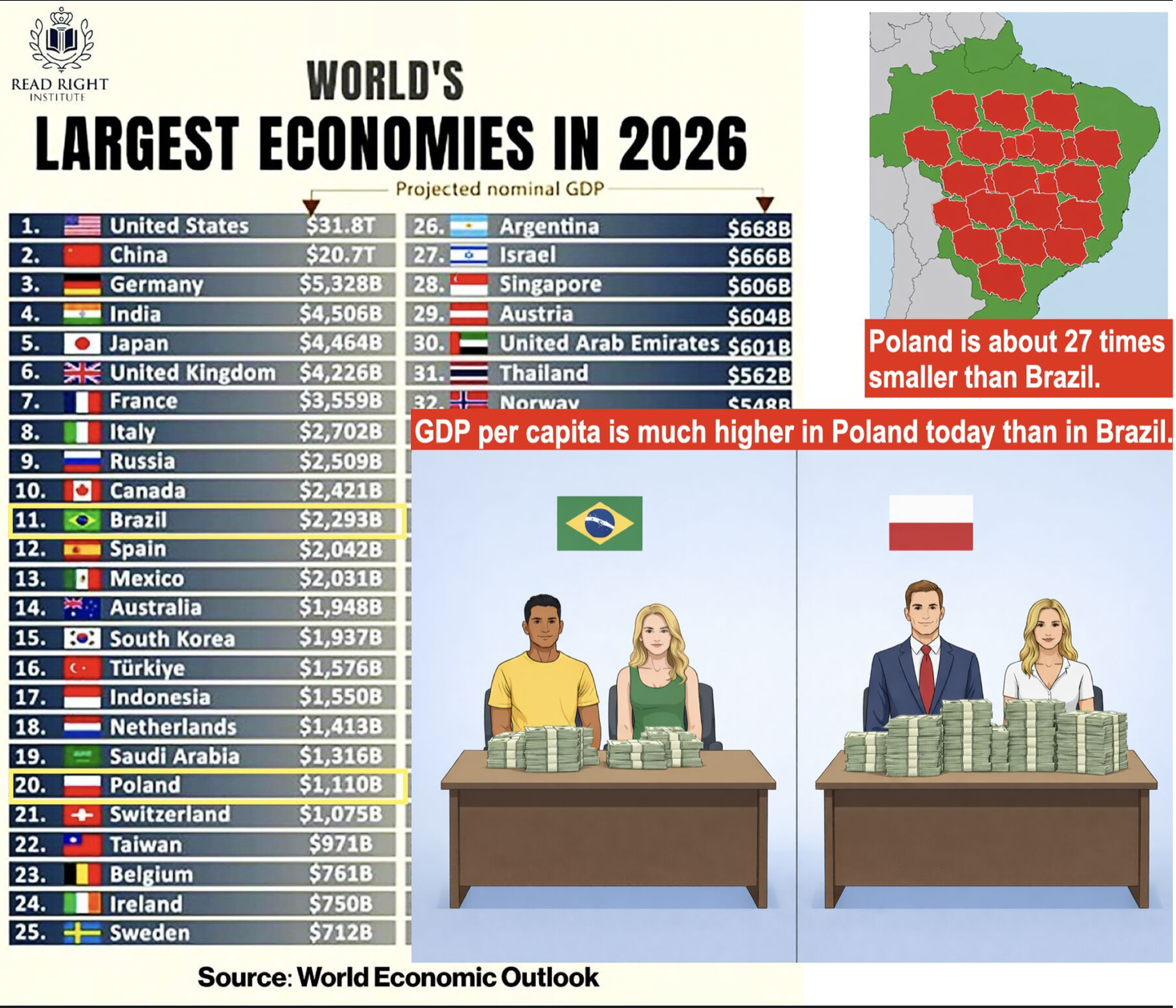
=> Poland is about 27 times smaller than Brazil and marked by a long history of devastation caused by wars and occupations by neighboring powers. => Despite this, Poland has managed to grow its economy so rapidly that its GDP now amounts to nearly half that of Brazil – a country vastly larger and endowed with extraordinary natural resources.
Economic comparison
=> In 2000, Brazil’s economy was about four times larger than Poland’s.
=> Today it is only about twice as large, showing how rapidly Poland has closed the economic gap. (Sources: World Bank / IMF datasets):
GDP in 2000
Brazil: ≈ $655 billion
Poland: ≈ $171 billion
GDP in 2025 (approx.)
• Brazil: ≈ $2.3 trillion
• Poland: ≈ $1.0 – 1.04 trillion
=> Poland’s GDP is now about 40–45% of Brazil’s GDP.
Even more striking
=> Population
• Brazil: ~203 million
• Poland: ~38 million
=> GDP per capita is therefore much higher in Poland today.
Poland’s economy expanded much faster, catching up dramatically despite the many adversities it has faced throughout its history.
Historical context
=> Brazil never experienced:
• foreign occupation of its territory
• nationwide destruction caused by war
• mass devastation of cities
• millions of war casualties
=> Poland, on the other hand, experienced:
• repeated invasions and foreign occupations
• massive destruction during German occupation and than World War II
• the destruction of cities such as Warsaw following the Warsaw Uprising, after which Warsaw was almost completely destroyed
• the mass killing of millions of Polish citizens and the severe decimation of Poland’s population and labor force during the German occupation (1939 – 1945)
Poland strongly expanded its export sector, especially after EU membership.
Key exports include:
• machinery
• vehicles and auto parts
• electronics
• furniture
• industrial equipment
Brazil’s economy, in contrast, has historically remained heavily dependent on commodity exports – a pattern that began during the imperial period with products such as sugar, gold, and coffee and continues today with commodities such as soy, iron ore, and oil.
A fundamental question:
Why has a country with far fewer natural resources and a history of devastation managed to close the economic gap so quickly with a country of continental scale and immense natural wealth?
Economic success depends more on the quality of institutions and governance than on the quantity of natural resources.