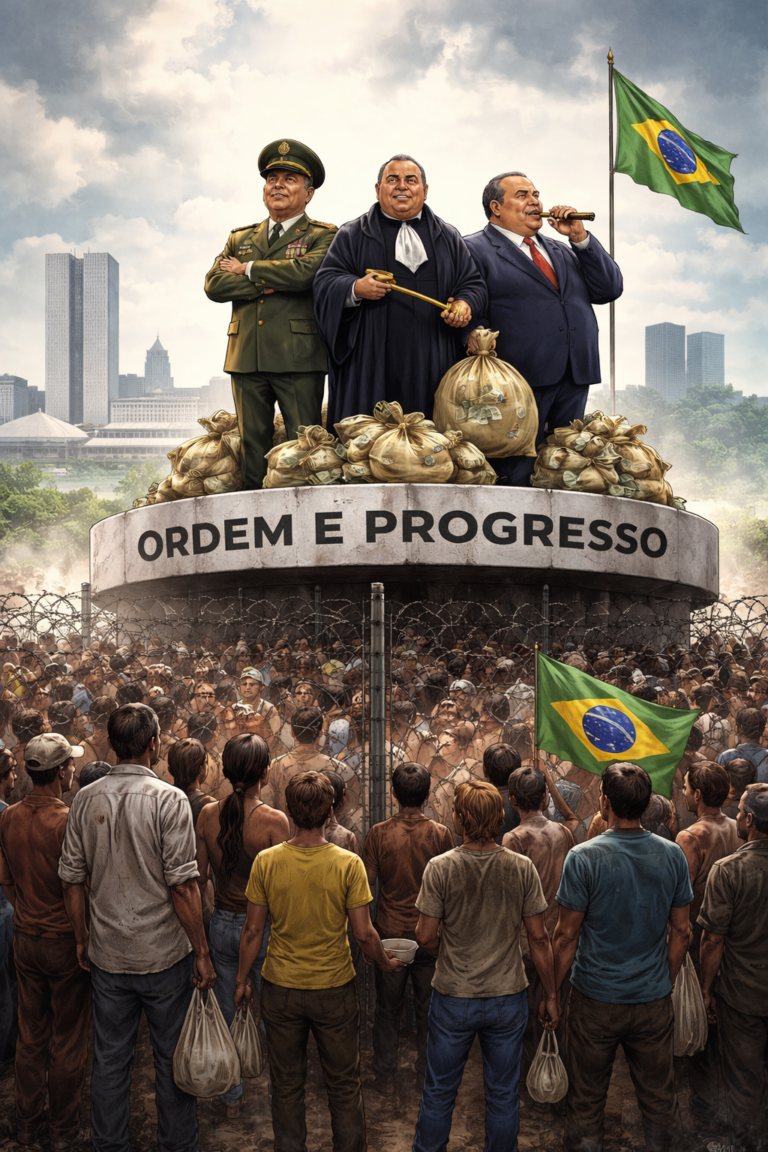
A Slave Who Dreams Not of Freedom, but of Power: Social Illusions and Control in Brazil
Brazil’s history is deeply marked by inequality, shaped over centuries by colonialism, slavery, and rigid social hierarchies. Even after the formal abolition of slavery in 1888, many of the underlying structures that sustained inequality remained intact. What changed was not necessarily the system—but the way people were positioned within it.
A troubling idea persists in many unequal societies: that success is not defined by freedom, dignity, or collective progress, but by dominance over others. In this mindset, rising in the social pyramid often means gaining control, status, and privilege—even if it comes at the expense of those below. The result is a cycle in which individuals who escape poverty sometimes adopt the very attitudes and practices that once oppressed them.
In Brazil, this dynamic has often intersected with politics. Leaders emerging from disadvantaged backgrounds have, at times, mobilized the poor to gain power—speaking their language, promising change, and positioning themselves as representatives of the marginalized. These campaigns often resonate deeply, because they tap into real grievances and long-standing injustices.
However, once in power, the pattern has sometimes shifted. Instead of dismantling the structures that perpetuate inequality, governments may implement policies that provide immediate relief—enough to ease suffering, but not enough to fundamentally transform people’s conditions. In this context, assistance programs risk being used less as pathways to empowerment and more as mechanisms of political control. They can foster dependency and shape voting behavior by creating the perception that survival depends on continued political support. Rather than equipping people to become independent and self-determined, such approaches may keep them in a vulnerable position—grateful for aid, yet unable to move beyond it.
This creates a paradox. On one hand, social support is essential in a country with deep poverty and inequality. On the other, when such support is not paired with long-term investments in education, critical thinking, and economic independence, it risks maintaining a population in a state of dependency. The poor are helped to survive—but not necessarily to become fully autonomous participants in society.
Education plays a central role in breaking this cycle. A well-educated population is harder to manipulate, more capable of holding leaders accountable, and better equipped to challenge unjust systems. When education is neglected or underfunded, the social pyramid remains stable—not because it is just, but because it is rarely questioned.
The deeper issue is cultural as much as political. If people are taught—explicitly or implicitly—that true success lies in climbing above others rather than lifting others up, inequality becomes self-reinforcing. The dream shifts from freedom for all to power for oneself.
Yet Brazil is also a country of resilience, creativity, and ongoing social struggle. Across its cities and rural areas, countless individuals, educators, activists, and communities are working to redefine success—not as domination, but as dignity, equality, and shared opportunity.
Breaking the cycle requires more than policy changes. It demands a transformation in values: from hierarchy to solidarity, from control to empowerment, and from survival to true freedom.
Only then can the dream change—from having “slaves of one’s own” to building a society where no one is a slave at all.